
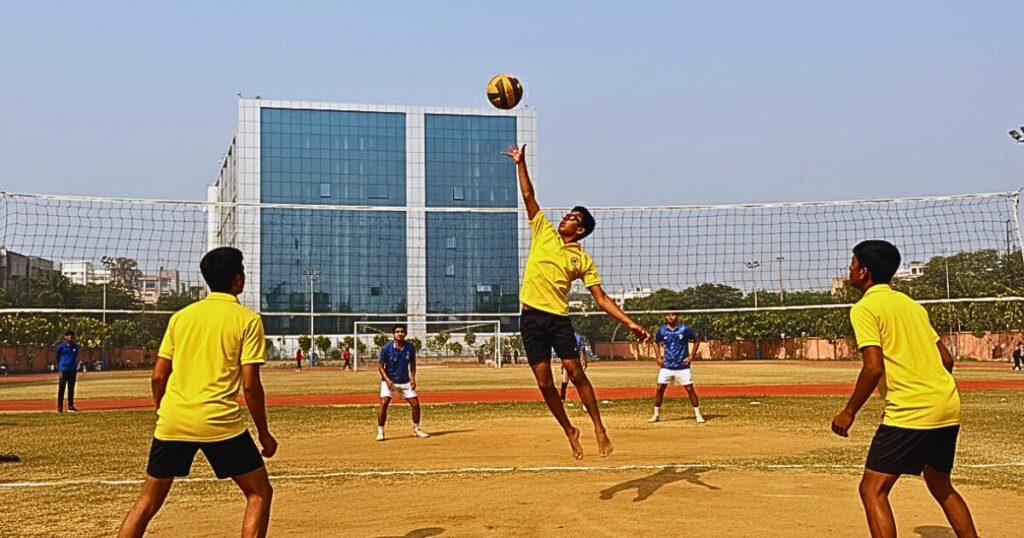
Throwball skills represent the core technical and tactical abilities required to excel in this fast-paced, non-contact team sport. Mastering these fundamentals is essential for maintaining the game’s high tempo and adhering to strict international regulations.
Whether you are competing on school or college playgrounds or at major SGFI (School Games Federation of India) tournaments, developing elite-level proficiency is the key to success. In throwball, players must build mastery in four core areas: catching, throwing, serving, and tactical positioning.
If you are a student preparing for CBSE or state board PE exams, learning throwball skills can help you. It is also useful if you are training for competitions with the School Games Federation of India. If you are a beginner learning throwball for intramurals, these skills will help you win matches more often.
Table of Contents
What Are the Fundamental Throwball Skills?
The fundamental skills of throwball are catching, throwing, serving, footwork, and communication. These allow for fast and effective play while adhering to the three-second rule.
It makes you a better player and helps you shine in PE practicals. Every successful player must master these essential techniques:
- Two-handed catching – Secure the ball with both hands to maintain control and avoid fouls
- One-handed throwing – Release the ball powerfully using a single hand within the 3-second rule
- Strategic serving – Initiate play with accuracy and placement to score points
- Quick footwork – Move efficiently to cover your zone in the 12.2m × 18.3m court
- Court awareness – Anticipate opponent movements and identify gaps
Pro Tip from Indian Schools: After watching many matches and talking to coaches, we found an important secret. Students who do 15-minute daily catching drills can boost their confidence and experience noticeable improvement. Perfect for morning practice or evening sessions in the society compound.
Throwball Skills Explained with Rules, Match Use & Exam Focus
| Skill Name | Rule Applied | When Used in a Match | Common Foul | PE Exam Value |
|---|---|---|---|---|
| Two-handed catching | Ball must be caught with both hands | Receiving serve or defending attacks | One-hand catch | Mandatory skill in practical |
| One-handed throwing | Release within 3 seconds | Counter-attacks and quick scoring | Holding ball too long | Frequently asked theory |
| Shoulder serve | Serve from behind end line within 5 seconds | Starting rally and targeting weak defender | Foot fault | Direct 1–2 marks |
| Smash throw | Overhand throw near net | Finishing attack at front zone | Telegraphing direction | Advanced skill mention |
| Lob throw | High arc throw into space | Breaking compact defense | Overuse of lobs | Tactical answer |
| Intercept catch | No net or center-line touch | Cutting diagonal throws | Late jump | Match-winning skill |
| Pivot movement | Pivot foot fixed while rotating | Creating throwing angle | Traveling | Common rule-based MCQ |
| Zone coverage | Players stay in assigned zones | Team defense structure | Ball watching | Diagram-based questions |
| Jump serve | Allowed only in select SGFI formats | Aggressive serve in school games | Illegal in TFI | Trick question favorite |
| Communication call | Verbal or hand signal allowed | Avoiding collision | Silence confusion | Teamwork evaluation |
Write Any Two Basic Skills of Throwball (Perfect PE Exam Answer)
If you’re preparing for Class 11 or Class 12 PE examinations where “write any two basic skills of throwball” appears frequently, this is your answer:
1. Catching Technique
The ball must be caught with both hands simultaneously as per official throwball rules. Position your hands in a W-shape with thumbs touching and fingers spread wide. Keep your eyes on the ball throughout its flight and cushion the impact by bringing your hands toward your chest.
Common mistake: Catching with one hand results in a foul and gives possession to opponents.
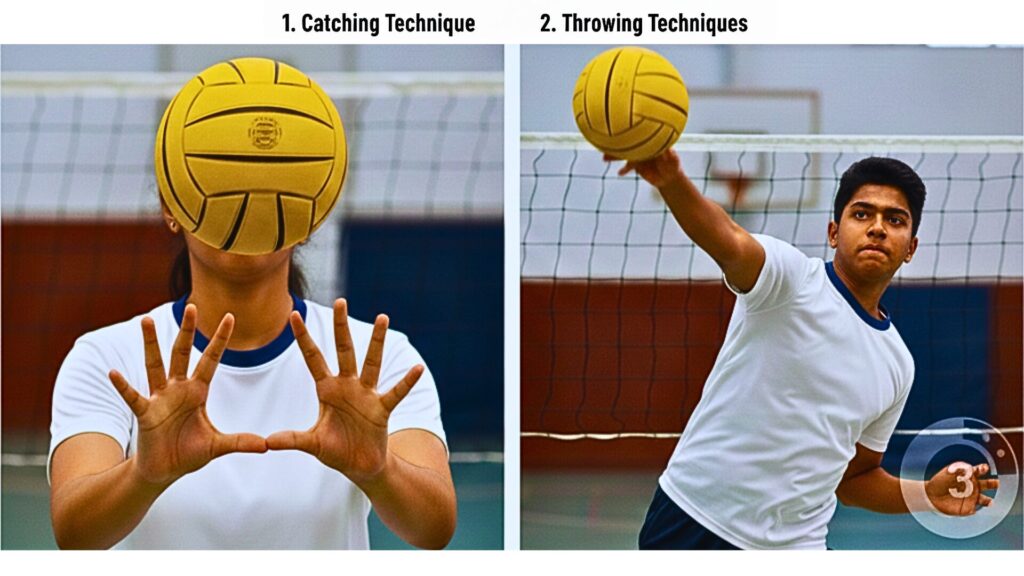
2. Throwing Techniques
After catching, you must throw the ball using one hand only in a continuous motion. The three-second rule applies; you have exactly three seconds from catch to release. Use your shoulder, elbow, and wrist in a whip-like motion to generate power and accuracy.
These two throwball skills are tested in every PE examination across CBSE, ICSE, and state boards, forming the basis for advanced throwball skills and techniques.
How to Practice Throwball Skills Effectively
Throw ball skills practice requires structured drills and consistent repetitions. Here’s our proven practice framework designed for Indian students:
Beginner Practice Routine (Week 1-2)
- Wall Catching Drill – Stand 3 meters from a wall, throw the ball, and catch the rebound with both hands. Complete 50 repetitions daily to build hand-eye coordination. It works perfectly for building terraces or compound walls.
- Partner Exchange – Face a partner 5 meters away in your society’s play area. Practice catching and throwing in one fluid motion. Focus on accuracy over power. Many students practice this in the housing society gardens between 5:30 and 7:00 PM.
- Footwork Practice – Use chalk or tape to create a ladder pattern in your room or terrace. Practice quick side-to-side movements for 10 minutes daily to improve court mobility.
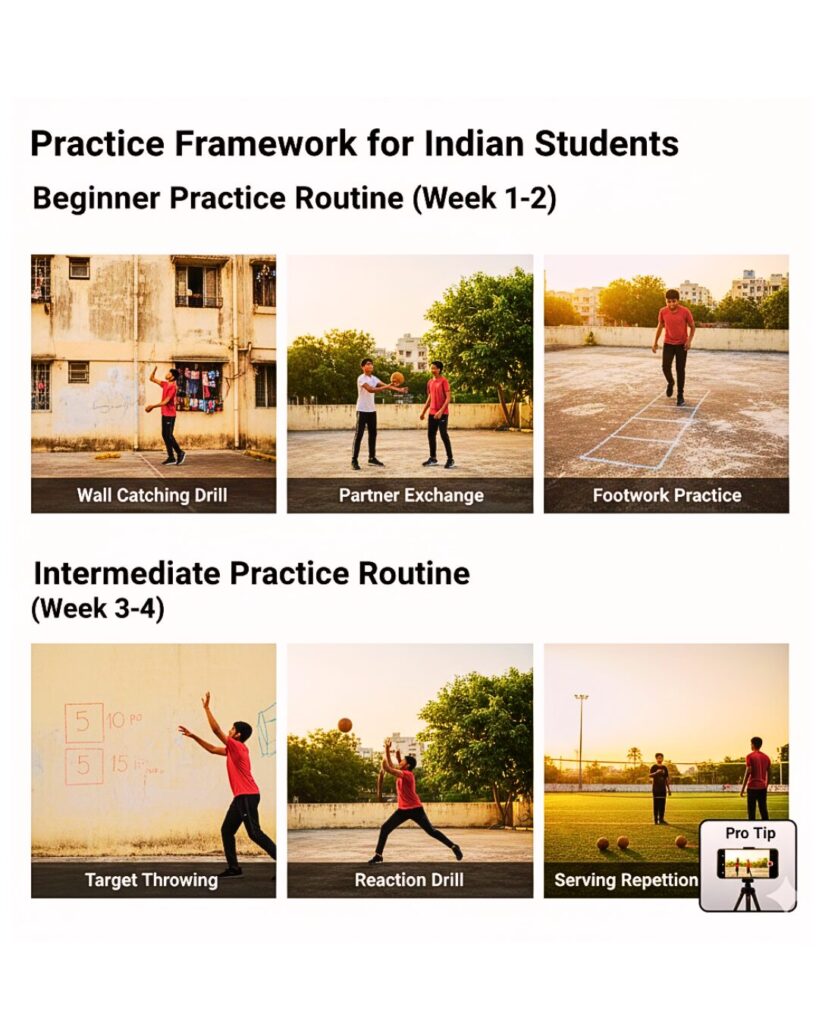
Intermediate Practice Routine (Week 3-4)
Target Throwing: Mark zones on a wall using chalk with numbers (5, 10, 15 points). Aim for specific targets to develop precision for throwball practice before tournaments.
Reaction Drills: Have a partner throw balls at varying speeds and angles. It simulates game pressure and improves defensive positioning.
Serving Repetitions: Practice all three serving techniques (underhand, shoulder, and overhand) for 20 repetitions each. Morning 6:30-7:00 AM or evening 6:00-7:00 PM slots work best.
Pro Tip: Record your practice sessions on your smartphone. Visual feedback helps students make faster corrections than verbal coaching alone.
What are the Names of Throwball Skills you should know?
Understanding throwball skills names helps you score marks in PE theory exams and communicate effectively with coaches.
Offensive Skills:
- Smash throw: A smash is an offensive overhand throw in throwball, executed with a jump near the net for a high-speed, downward trajectory to score a point.
- Lob throw: A lob is a high, slow throwball shot sent carefully into an empty space on the court, making it hard for the other team to catch.
- Quick release: Quick release means catching with two hands and throwing over the net with one hand very fast. It’s a key throwball rule.
- Deceptive throw: In throwball, smart players use fakes and clever throws to trick defenders, creating open spaces to score easy points for their team.
- Diagonal cross-court throw: A diagonal cross-court throw sends the ball corner-to-corner, stretching opponents’ defense and creating open spaces.
Defensive Skills:
- Intercept catch: An intercept is a defensive skill where you steal the ball mid-pass from your opponent. It’s a risky but exciting move that gives your team possession.
- Block positioning: Forward-line players use blocking to stop the opponent’s throw at the net. This key defensive skill slows the ball down, making it easier for their teammates to catch.
- Recovery dive: A recovery dive in throwball is a desperate, full-length lunge to save a low, far ball and keep the rally alive.
- Zone coverage: It is a strategy where seven players guard specific court areas, divided into front, center, and back zones, to catch and return the ball.
- Communication call: Verbal signals to avoid collision.
Serving Variations:
- Underhand serve: The underhand serve is a safe, accurate throwball starter. You swing your arm like a pendulum to lift the ball over the net.
- Shoulder serve: You must use a shoulder serve to start play, throwing the ball over the net from above your shoulder. Underarm or side-arm serves are fouls and not allowed.
- Jump serve: Jump serving is generally permitted in SGFI and not permitted in most TFI-regulated competitions. It may appear only in limited non-federation or experimental formats. Players should always follow tournament-specific rules.
- Float serve: A float serve is a sharp throw where you hit the ball without spin. As it dances in the air, it becomes hard for the other team to secure a clean catch.
- Topspin serve: A topspin serve in throwball is a powerful, spinning throw. It makes the ball dip sharply over the net and bounce fast, making it very hard for the opponents to catch.
Exam Tip: CBSE PE theory exams frequently ask “List any five throwball skills names” for 5 marks. Memorize at least 3 offensive, 3 defensive, and 2 serving skills for full marks.
Throw Ball tricks to win for Beginners
These throwball tricks to win for beginners give you a competitive edge in school tournaments and SGFI competitions:
Trick 1: The Delayed Release
Catch the ball and pause for 1.5-2 seconds while scanning opponent positioning. Most beginners rush throws, making them predictable. Use the full three-second window strategically to identify gaps.
Trick 2: Corner Targeting
Always aim for the back corners of the opponent’s court. It forces defenders to cover a maximum distance (6-7 meters) and results in higher error rates. Practice throwing to all four corners during throwball practice sessions.
Trick 3: Height Variation
Alternate between high lobs (4-5 meter peak) and fast, flat throws (1.5-2 meter clearance). This rhythm disruption makes timing difficult for opponents. This single strategy helps underdog teams defeat stronger opponents in school tournaments.
Trick 4: Fake Motion
Begin your throwing motion toward one direction, then quickly redirect mid-throw using wrist snap. It requires 3-4 weeks of wrist strengthening but is highly effective against inexperienced defenders.
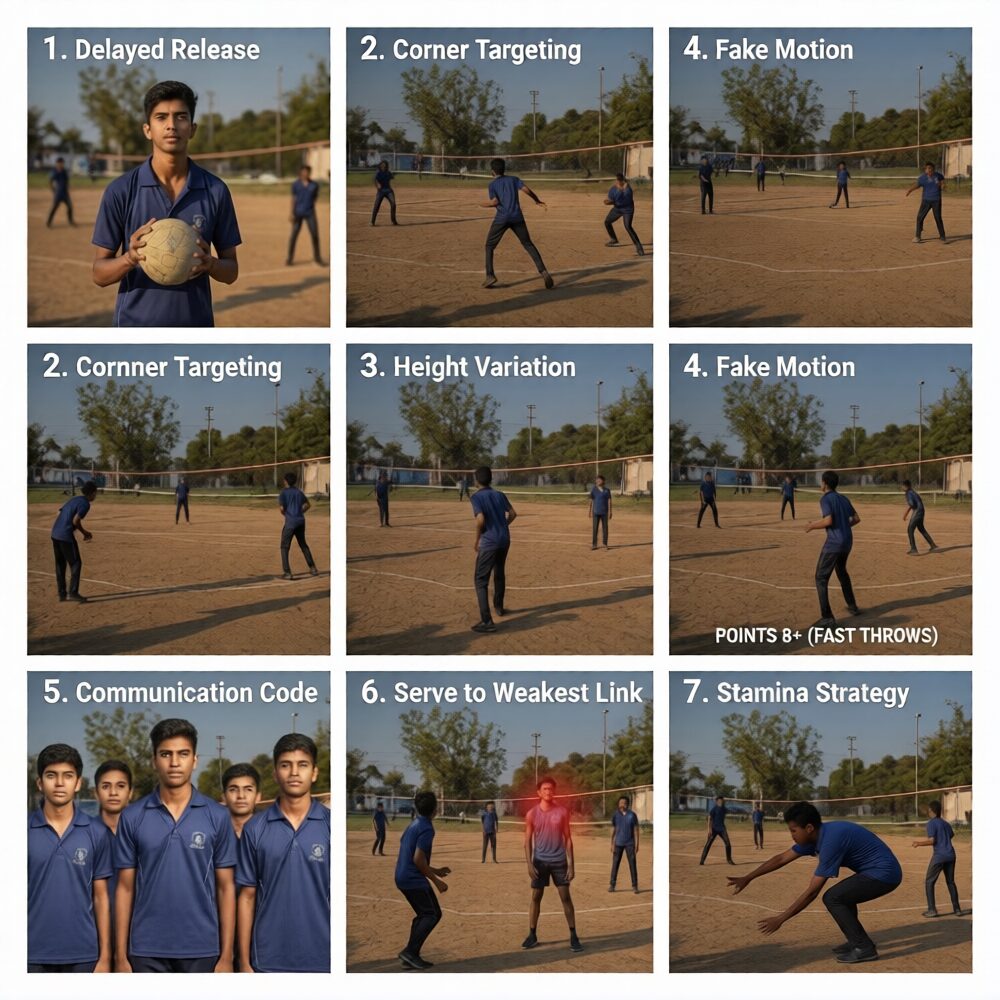
Trick 5: Communication Code
Create easy hand signals with your team to show throwing styles: one finger for straight throws, two for diagonal, and a fist for lobs. In competitive throwball games at SGFI levels, coordinated attacks score more points than random efforts.
Trick 6: Serve to the Weakest Link
During warm-up, identify which opponent has the weakest catching technique. When serving, target that player strategically. This psychological pressure forces more errors.
Trick 7: Third Set Stamina Strategy
If the match reaches the third set, use the first 7 points for corner throws and lobs to tire opponents. Then switch to quick flat throws when they’re exhausted. It works exceptionally well in hot-weather tournaments.
What Throwball Skills and Techniques Separate Good Players from Great Ones?
Advanced throwball skills and techniques focus on game intelligence and tactical execution:
Spatial Awareness
Great players constantly scan the court using peripheral vision, identifying gaps in opponent formation. They throw to empty spaces rather than at defenders, forcing opponents to cover 5-7 meters rapidly.
Training Drill: Practice court visualization by standing in the center court with eyes closed. Have teammates call out positions, and you point to that location within 1 second. This mental mapping improves spatial intelligence.
Tempo Control
Elite players vary in throwing speed throughout matches. Fast throws in the first set, followed by strategic lobs in the second set, keep opponents mentally fatigued and reactive rather than proactive.
Championship Strategy: Use “speed burst” tactics—7 fast throws in 90 seconds followed by 3 slow lobs. This deliberate pacing causes opponent error rates.
Energy Management
Position strategically to minimize unnecessary movement while maintaining readiness. Great players cover their zone (3m × 4.5m) efficiently using 2-3 steps maximum per rally, while average players run 5-7 unnecessary steps.
Fitness Impact: A typical match involves 45-75 rallies. Wasting 4 extra steps per rally means 150-250 meters of unnecessary running, causing significant third-set fatigue.
Psychological Strength
Maintain confident body language even after errors. Teams that celebrate small victories (successful catches, good positioning) maintain higher morale in close matches.
Body Language Techniques:
- After your error: Clap hands once, say “Next one!”
- After teammate’s error: Thumbs up + “Good try!”
- During opponent’s service: Stand tall, bounce on toes, showing readiness
Serve Placement Intelligence
Advanced servers target specific vulnerable players based on warm-up observation:
- Weakest catcher (the shortest player or the one making errors)
- The seam between two defenders (where communication breaks down)
- Deep corners (requiring maximum backward movement)
Team Synchronization
Championship teams develop non-verbal signals:
- Fist behind back = Lob throw coming
- Open palm = Fast throw coming
- Two fingers = Diagonal cross-court throw
Practice Drill: Enforce “silent rallies” where no verbal communication is allowed for 10 rallies. This builds instinctive coordination, crucial when crowd noise prevents verbal calls.
How long does it take to learn throwball skills?
Most beginners can master basic catching and throwing techniques within 2 to 4 weeks of consistent practice. Competitive-level proficiency typically requires 3 to 6 months of structured training with regular match experience.
What is the hardest throwball skill to master?
The jump serve is considered the most challenging throwball game skill because it requires perfect timing, explosive leg power, and precise ball placement simultaneously. Even experienced players need 6+ months to develop consistent jump serves.
Can I practice throwball skills alone?
Yes, wall drills are highly effective for solo throwball practice. Focus on catching rebounds, target accuracy, and serving technique against a wall marked with target zones. It requires no partner and can be done in building terraces or compound areas.
What equipment do I need for throwball skills practice?
You need an official throwball (smaller and lighter than volleyball, weighing 400-450 grams), athletic shoes with good lateral support, and comfortable sportswear. A regulation net helps, but isn’t essential for basic throwball skills practice.
What are the best throwball drills for beginners?
Start with partner catch-and-throw drills, wall rebound exercises, and serving practice. These three drills develop all fundamental skills of throwball without overwhelming new players. Daily 15-minute sessions show results within 2 weeks.
Which Indian states are strongest in throwball?
Maharashtra, Karnataka, Tamil Nadu, and Kerala dominate the SGFI national championships. These states have established training infrastructure and include throwball in school PE curriculum from Class 6 onwards.
Is throwball played professionally in India?
Yes, throwball has professional leagues and national championships organized by the Throwball Federation of India(TFI). The sport is also played at university and corporate levels, with All India Inter-University Throwball Championships held annually.
Your Next Steps to Throwball Mastery
If you want to develop elite throwball skills, you need dedication, smart practice, and a strategic understanding of throwball rules. Start with the two basic skills—catching and throwing—then gradually combine advanced techniques and game strategies.
Action Plan:
- Practice the beginner routine for 15-20 minutes daily
- Record yourself to identify form improvements
- Study opponent patterns during practice matches
- Review the throwball rules before competitions
- Implement one new throwball trick each week
- Join your school team or local club for regular match practice
Whether you’re preparing for CBSE/ICSE PE examinations, SGFI school tournaments, or college competitions, these throwball skills and techniques will transform your game performance. Remember one thing: champions begin as learners and become masters through dedicated, consistent, purposeful practice.
Start implementing these drills today, and you’ll see measurable improvement in your throwball skills practice within just two weeks. Focus on mastering the fundamental skills of throwball first, then progress to advanced tactics and winning strategies.
Stay tuned with Sports Dribble and its Facebook, Instagram, and Twitter accounts for updates!

My name is Krishanu Das the founder of the Sports Dribble.
I am Accountant by profession but a Sports Blogger by passion.
I am passionate about sharing my all knowledge and experiences of sports, with my readers and every sports enthusiast.