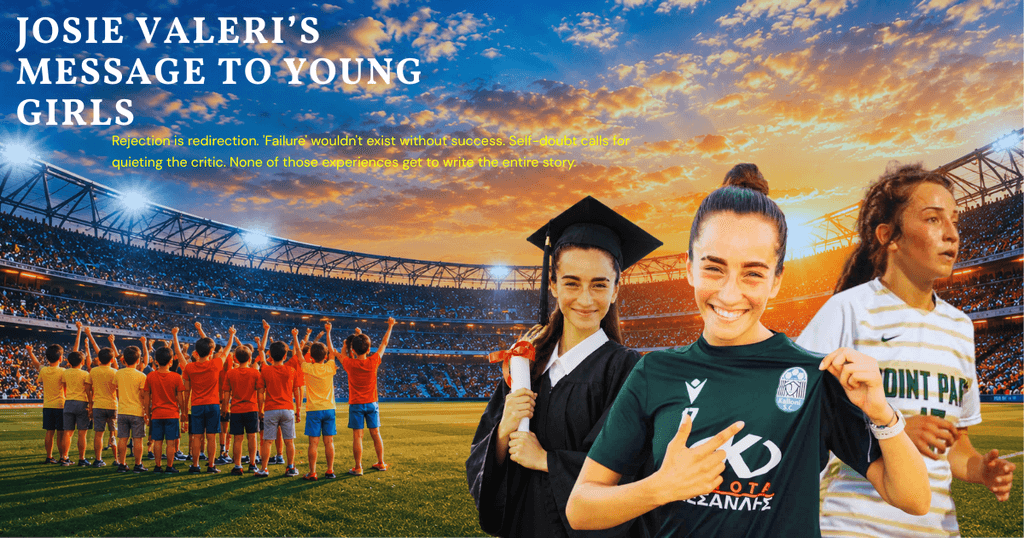
Josie Valeri is a professional defender for A.P.G.M.S. Kalloni and earned her PhD in Critical Psychology from Point Park University in June 2025 at 24. She says psychology and soccer go hand in hand.
At three years old, little Josie Valeri only knew that she liked having a soccer ball at her feet. At 7, she realised her passion for soccer when she entered Riverhounds Development Academy.
But how did psychology enter the game?
For some young players, soccer and school can feel like competing paths. Valeri refused to treat them that way.
Who is Josie Valeri?
We already know Josie is an American professional soccer player and psychologist who plays as a defender, primarily outside back and center back, and plays professional football in Greece. She runs her own professional venture, Infrapersonal Works.
Sports Dribble spoke with Valeri about growing up in the game, recovering from two ACL tears, earning her doctorate, learning to speak in a new country, and what she wants young players to understand about their own paths.
The girl at the YMCA
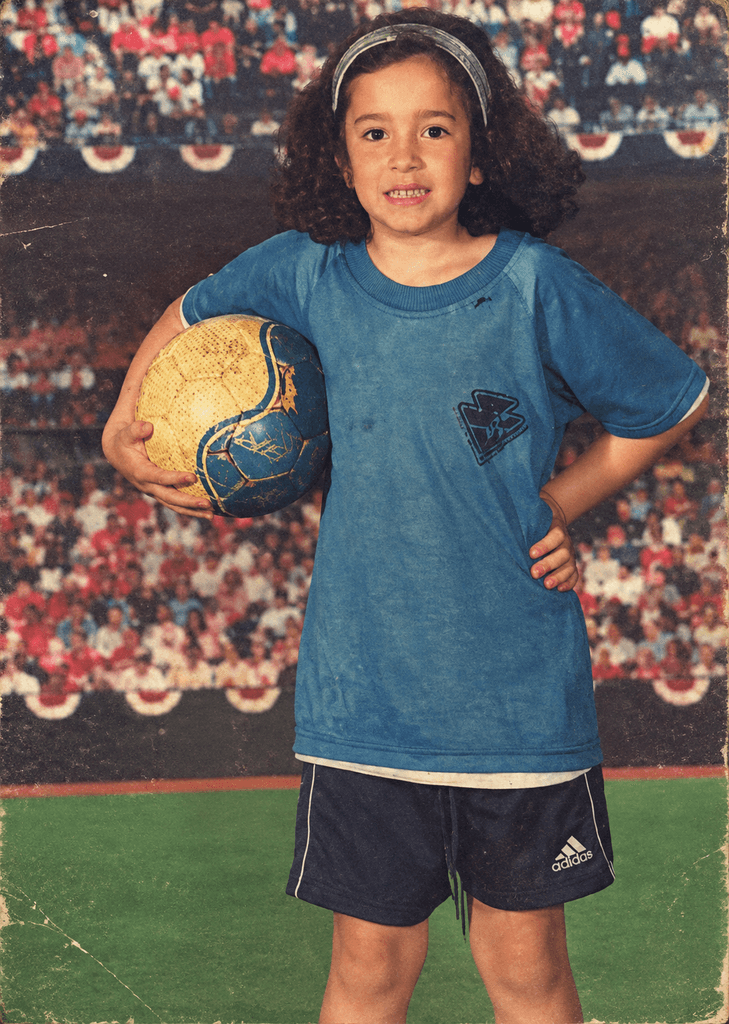
Josie Valeri started playing soccer at age three at her local YMCA, a community organization. No academy. No plan. Her mother coached her first.
Around age seven, it turned into something else. She entered the Riverhounds Development Academy and moved up from Tier 2 to Tier 1.
Once, a mentor told her he could not wait to see her on a Wheaties box. When I asked who believed in her before anyone else did, Valeri refused to name one person.
“Genuinely, my family, community, and mentors continue to be with me from the beginning. I carry pieces of all of that support with me.”
Her family calls her Jo. Coaches have called her “Jersey” and “Doc.”
But when I ask her for one name, her voice proudly says, “You can call me Valeri! It is my last name, and it is special to me because I am one of the few people who can carry on its legacy.”
The part nobody could see
Long before, when she tried to balance both, Valeri worked on something more basic. As a young girl, she carried depression and anxiety. From the outside, none of it showed. She named the people who stayed.
“I give massive credit to my parents, Kristen and Carlo Valeri, my grandparents, Kathy and Ken Burr, my mentors, and my sister, Maeve Valeri, for their ongoing support as I learned that I bring value to the world.”
The achievements came later. The childhood and teenage years underneath them were not easy.
What kind of defender is Josie Valeri?
Valeri plays outside back and center back. Ask her what runs through her head in the seconds before an attacker tries to get in behind, and the answer is not drama. It is a decision tree she has already run.
“I primarily play outside back and center back, so I tend to proactively shut down that option.”
If the attacker strays offside, she lets them. The ball comes back to her team anyway. If they stay onside, she does not wait for the play to develop.
“When they stay onside, my first priority is to get to the ball quickly and help my team regain possession.”
Her philosophy under pressure fits on a business card.
“Keep. It. Simple. I play what makes sense.”
The matches she remembers are not the tidy ones.
“I love when I perform unapologetically aggressive. It reminds me I can present my personality in a genuinely competitive way.”
Clean tackles, quick transitions, chances created from the back. That is her flow state. In her words, those moments let her help raise the level of the game around her.
Two ACLs, two menisci, and a label she would not accept
Valeri has torn both ACLs, one in each leg. She has also torn two menisci in her right leg.
In her account, getting cleared ahead of schedule became routine. Each rehab brought its own set of problems.
What interests her is not the damage. It is what other people do with it.
“I do not let my injury history define me, and I do not let it become a reason for people to view me as a risk.”
She describes playing now with a “liberated sense of appreciation and bodily awareness.”
The injuries stayed in her medical file. They did not become her name.
Josie Valeri made sacrifices. Just not the ones people assume
Through school, Valeri missed social events. Plenty of them. Her priorities lived somewhere else.
The trade-offs look different now.
“As I evolve, I focus more on letting go of habits, dynamics, and systems that don’t make room for the best version of myself.”
Asked whether juggling soccer, education, and a personal life ever got hard, the answer arrived fast.
“Oh yeah, no one said it was easy!”
Her personal life sometimes fades into the background. She says so without apology, and she keeps a few routines she calls sacred, which hold the rest of it together.
Valeri did not sacrifice her dreams. She made sacrifices around them.
The doubters got her work, not her arguments
Some of it was trolling. Some of it came from people who genuinely cared about her and still had reservations about chasing professional soccer and a doctorate at the same time.
Her answer was not defiance. It was arithmetic about where her energy goes.
“I keep my effort on my path rather than spend my energy convincing everyone else. My response is to keep doing the work.”
Today Valeri runs her own business, Infrapersonal Works, alongside her playing career and her research.
Psychology found her by accident

Now we talk about how psychology entered the game.
A coach at the Olympic Development Program happened to be studying psychology. That detail lodged somewhere in a young Valeri’s head.
So she took a psychology class at university without knowing where it would lead.
“I honestly had no intention of getting into psychology this deeply, but I am in love with the field now.”
Curiosity turned into coursework. Coursework turned into research. Research turned into a dissertation nobody had planned for her.
Josie Valeri defended that dissertation at 23. The degree was conferred over the summer, arriving just after her 24th birthday.
Valeri says her review of published dissertations led her to believe she is one of two documented people, and the first woman, to successfully defend a PhD in Critical Psychology. She adds that the claim rests on published records and remains open to further confirmation.
Then came the moment she still replays.
She celebrated, and then corrected herself.
“I did it! No, I’m doing it!”
The correction says something about how Valeri sees the achievement. The degree was not permission to stop.
She is not two people. She is one
Most headlines call her the soccer player with a PhD. Valeri does not experience her life as two files in two folders.
“I do not experience psychology and soccer as separate worlds.”
The research shows up on the field, in the least academic way possible. On the field, that training shows up in how she communicates with teammates.
“Psychology helps me attune to timing, tone, body language, and what people around me need. Across languages, one or two words get to the point during a match.”
Peripheral awareness. Returning to her breath. Those, she says, are her favorite moments under pressure.
The question is not how Valeri manages two careers. It is why anyone assumed she needed to split herself in half.
Greece, and learning to have a voice again
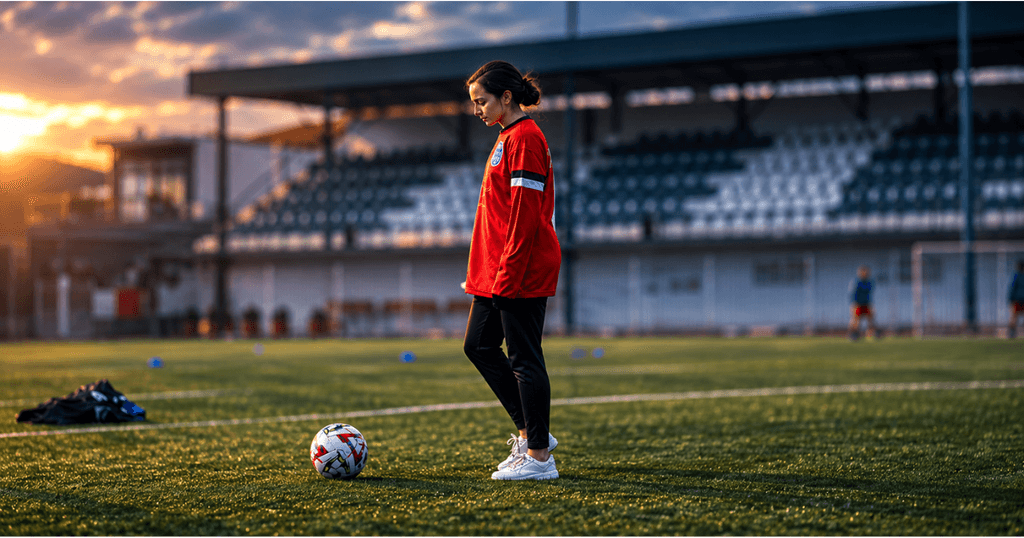
An agent arranged a trial with a Greek club, negotiated her first professional contract, and Valeri took it. She wants to see what professional football in Greece actually feels like while continuing her education and building a life across an ocean.
The first hard part had nothing to do with football.
“Finding my voice was difficult at first, but I naturally adjusted.”
She has traveled alone since she was young. But playing in a language that is not yours changes what confidence means.
“Immersion into the real-time language barriers encourages me to accept the beauty of the ‘imperfect’ that makes understanding much more doable.”
Then there is the Greece that never appears on a team sheet.
“There is something about having a freddo espresso with a spanakopita while listening to Pantelis Pantelidis that words cannot describe. It adds a passionate heartbeat to playing football here.”
What Josie Valeri wants young girls to know
Valeri has coached and developed young players. Her advice doesn’t fit on a poster.
When a 13-year-old worries she has to choose between football and academics, Valeri doesn’t say, “You can do both.” She widens the frame instead.
“There is more to who we are as humans than either football or academics. What are some other activities that bring meaning to your life?”
For the girl who says she is not talented enough to go pro, Valeri does not argue. She adds to the list, then turns the question around.
“Talent matters, sure. So does effort, discipline, relationships, role refinement, composure, and preparedness to win. Where did that thought and/or feeling of not being enough of something come from?”
On rejection and self-doubt, she is careful to say this is something she is still practicing herself.
“Rejection is redirection. ‘Failure’ wouldn’t exist without success. Self-doubt calls for quieting the critic. None of those experiences get to write the entire story.”
And on what she wishes someone had told her at that age, four words.
“Don’t overthink it!”
Football, she says, is enjoyable because it lets a player express what makes her different.
Valeri also thinks adults carry part of this weight. She wants coaches, parents, and clubs to keep young players feeling safe and secure, to challenge the old “just push through it” line, and to adjust the system around what players actually need.
Back to the girl with the ball
I asked Valeri what she would say to the three-year-old who first kicked a ball at that YMCA.
“Learn it while living it. The journey’s about to get more fun, more brilliant, more creative.”
That little girl did not know about the torn knees. Or the dissertation defense at 23. Or the spanakopita before a match in a country she had never seen.
She just knew she liked the ball at her feet.
Still playing. Still studying. Still figuring it out.
Still doing it.
Keep up to date with Sports Dribble and its Facebook, Instagram, and Twitter accounts for updates!

Krishanu Das is the founder and lead writer of Sports Dribble. With more than five years of experience in sports writing, he specializes in creating well-researched guides, sports rules, player rankings, tournament explainers, and match analysis across cricket, football, basketball, tennis, volleyball, and many other sports.
Although he works as an accountant by profession, sports have always been his lifelong interest. That passion inspired him to build Sports Dribble, where he focuses on publishing accurate, easy-to-understand, and regularly updated content for sports fans around the world.
Before every article is published, Krishanu researches official rulebooks, governing bodies, tournament regulations, trusted statistics, and reliable sources to ensure readers receive factual and up-to-date information. His goal is simple: help every reader understand the game with clear explanations, practical insights, and information they can trust.