
Arsenal Tactical Analysis: Why Arteta’s Side Are Stronger
Arsenal won the league by being the hardest side in England to score against. Now, they cut teams open too, and Brighton and Newcastle have shown where the seams are.

This Arsenal tactical analysis looks at how Mikel Arteta turned his title-winning side into a team that can defend deep, press high and create chances through attacking rotations. Arsenal won the 2025/26 Premier League title through defensive control. Now their midfield structure, right-side combinations and movement in the final third give opponents more problems to solve.
Mikel Arteta’s team have nine wins from 11 league games and sit six points clear of Brighton, who have a game in hand. Yet Brighton beat Arsenal 3-0 in September. That night showed exactly where this team can still be hurt.
Saturday brought a second warning. Arsenal led at St James’ Park, lost their grip after the break, and needed Noni Madueke to rescue a 2-2 draw.
This piece shows how Mikel Arteta’s tactics built that control, and where opponents keep finding gaps.
Key Takeaways
- Arsenal won the 2025/26 title on 85 points, seven clear of Manchester City, and conceded only 27 league goals.
- The 4-2-3-1 on the team sheet becomes a moving shape with the ball. Ben White tucks in and Riccardo Calafiori attacks the left half-space.
- Rotations pull markers out of position. In the first three league games of 2026/27, 47.5% of Arsenal’s attacking-half touches came down the right.
- Corners brought 19 goals last season, a Premier League record. None came in the first seven league games this term.
- Brighton (3-0) and Newcastle (2-2) both hurt Arsenal by pressing their build-up.
How Mikel Arteta rebuilt Arsenal into champions
The title was not a sudden leap. Arsenal finished second three seasons running before they won the 2025/26 league, their first in 22 years. Manchester City’s 1-1 draw at Bournemouth confirmed it with a game to spare. Arsenal ended on 85 points, seven clear of City, with 71 goals scored and 27 conceded.
Arteta was 44 years and 54 days old when it came. That makes him the youngest manager in Arsenal’s history to win the league, and only José Mourinho has won the Premier League at a younger age. He did it with the youngest squad in the division, averaging just under 25 years old.
The season ended badly. Arsenal went ahead in the Champions League final through Kai Havertz, drew 1-1 with Paris Saint-Germain and lost 4-3 on penalties. It fits the pattern that runs through this piece. Arsenal are formidable without the ball and less certain when a good side takes away their rhythm on it.
Arsenal Formation: How Arteta changes shape in each phase
For years Arsenal were a 4-3-3 side. In 2025/26 Arteta turned to a 4-2-3-1 far more often. The Premier League’s own analysis counts 13 uses in 37 league games in its sample. Arsenal’s club analysis counts 14 in 38. The catalyst was the arrival of Martin Zubimendi, which gave Arteta a second holding midfielder.
The team sheet only tells you where players start. Against Chelsea on 6 September, Arsenal lined up in a 4-2-3-1 with Declan Rice and Myles Lewis-Skelly in midfield. With the ball, they looked different. Havertz drifted out to the right and White tucked inside. Calafiori slid into the left half-space while Christos Tzolis held the width on the left.
Rice, Zubimendi and the midfield behind Arsenal’s control
Arsenal’s 2025/26 spine was David Raya, William Saliba, Gabriel, Rice and Zubimendi. Raya started 37 league games, Rice 35 and Zubimendi 33. Saliba and Gabriel made 30 each. No one else started more than 28.
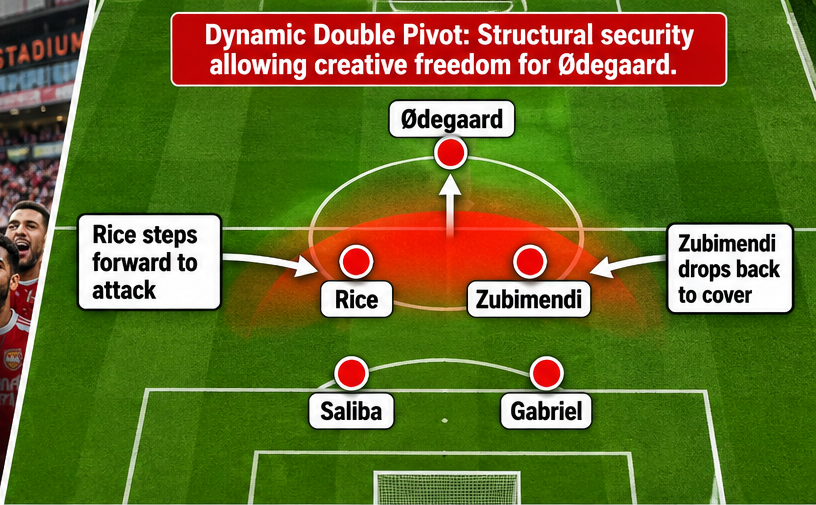
Zubimendi changed Rice’s job. Rice began the season box-to-box and ended it as a holder or half of a pivot. He no longer had to carry the ball, screen the centre-backs and arrive late in the box on his own. One of the pair steps forward while the other stays. It is the clearest shift of the Arteta era.
The pivot also frees Martin Ødegaard to receive between the lines instead of dropping deep to fetch it. Most of Arsenal’s creative moves run through him, so the security behind him matters.
Raya as the extra passer
In possession, Arsenal use Raya as an extra passer. That gives them a spare man against the first line of the press. When an opponent closes the central lanes, he must play around the press or go long. Either choice carries a cost.
Brighton showed it. Raya’s pass went straight to Yasin Ayari, and only a last-ditch challenge from Rice prevented a clear chance. A pivot protects what sits in front of it. It cannot rescue a poor first pass. Raya also went off with a shoulder injury at Newcastle, so his fitness now matters to the build-up too.
Arsenal Attacking Tactics: How rotations break man-marking
Arsenal’s attacking structure leaves defenders in a classic predicament: follow their marker out of position or hold their shape and surrender space. That tension has become a central part of Mikel Arteta’s side. Chelsea’s recent visit to the Emirates offered two clear examples of how those rotations pull a backline apart.
Goal one, the equaliser (25 minutes). Chelsea’s early lead had stretched them. Josh Acheampong pushed up their right, which pulled Maxence Lacroix wide to deal with Havertz and opened gaps across the back line. Later Havertz drifted right again beside Ødegaard and Bukayo Saka, with White rotating inside and Rice nearby. Arsenal built a 3v2 against Rogers and Hato several times. Havertz scored from a wide-right position after taking the ball there.
Goal two, Ødegaard (50 minutes). Tzolis drove inside from the left while Calafiori made a half-space run. That pulled Lacroix and Neto toward them, and Lavia was dragged across too. A big gap opened between Lavia and Reece James. James could not recover to track Ødegaard’s run, and Tzolis found the captain in the middle.
Man-marking asks every defender to follow a runner. Arsenal give each defender a different runner and a different space. If the centre-back follows Havertz wide, the back line splits and the middle opens. If he stays, Havertz receives with time and a free team-mate outside him. Either way, something is open.

Why the right flank is Arsenal’s main route
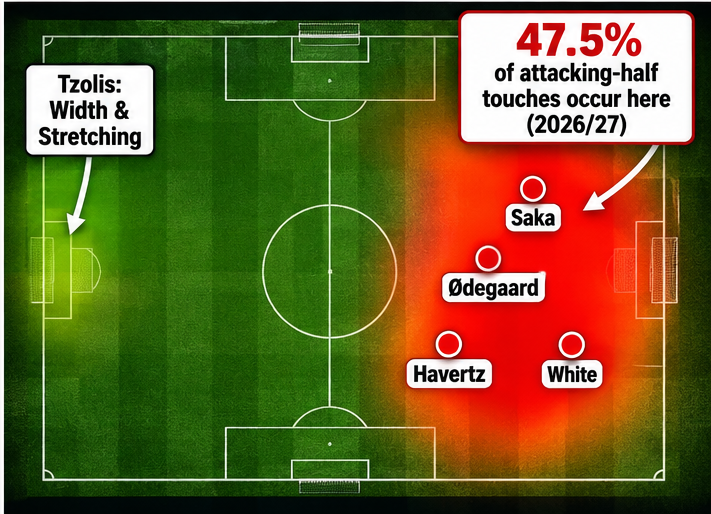
Arsenal attack down the right more than any other side. In 2025/26, 41.7% of their attacking half-touches came on the right and 31.8% on the left, the lowest left-side share in the league. In the first three league games of 2026/27, Opta put the split at 47.5% and 27.4%.
| Sample | Right-flank share | Left-flank share | Source |
| 2025/26 (attacking-half touches) | 41.7% | 31.8% | Opta Analyst |
| 2026/27, first three league games | 47.5% | 27.4% | Opta Analyst |
Saka, Ødegaard, White and Havertz produce 3v2s down that flank. Against Napoli in the Champions League, Arsenal recorded 4.05 expected goals, their highest in the competition since 2012/13. Opta’s passing network showed the ball going right again and again.
The left works differently. Tzolis holds the width and has had four assists in his first five competitive games. Calafiori moves inside him to attack the box, almost like a second striker when Havertz leaves the middle. He averages only 39.6 touches per 90, which is low for a full-back, because his job is arriving, not circulating.
Opta adds a warning. Nobody has yet shut down that right side, so nobody knows how Arsenal would respond. They were less effective in open play when Saka was absent last season.
How Arsenal create danger without taking risks
None of this depends on one player beating another. Arsenal win the right side with angles, spacing and runs from deep. That is why their numbers look so odd.
Critics used to call Arsenal cautious. Opta’s early-season data points to a side that does not need risk.
- After four league games, Arsenal had the highest final-third pass completion in the league at 81.2%.
- They ranked 19th for dribbles attempted (43) and last for dribbles completed (17).
- Their average expected threat (xT) per final-third pass ranked fourth at 0.13.
Expected threat measures how much a pass raises the chance of a shot in the next ten seconds. Tottenham and Aston Villa also played very safe final-third passes but created little. Arsenal’s safe passes carry danger because the rotations have already dragged opponents out of shape. (Opta data to 17 September 2026, a four-game sample.)
Set pieces, the second route to goals
The 2025/26 set-piece record is the most quoted reason Arsenal won the league, and it is earned. They scored 25 goals from set pieces excluding penalties, the most in the division. Nineteen came from corners, a Premier League record. Fourteen of the first 18 corner goals gave Arsenal a 1-0 lead (Premier League count after 37 games).
The routine starts with the near-post rush. Runners come from the back post toward the front and crowd the six-yard box, which causes marking errors. Rice delivered the corner for eight of those first 18 goals, mostly inswingers. Saka delivered six with his left foot. Gabriel was involved in five.
Arsenal crossed the ball into the box from 86.6% of corners in 2025/26 and went short on 13.0%.
This season the corners have dried up. Opta reported no corner goals in Arsenal’s first seven league games, and no non-penalty set-piece goal in any competition. At the same stage last season, they already had six from corners. That is the clearest sign the dead-ball route has become a bonus rather than a crutch.
Arsenal Defensive Structure: How Arteta stops shots
Arsenal’s defensive organisation is built to snuff out danger long before a shot is ever taken. Through a compact midfield block, coordinated pressing triggers, and disciplined positioning from his centre-backs, Mikel Arteta denies opponents the time and space needed to carve out clear-cut chances. The final 2025/26 numbers show it. Arsenal conceded 27 league goals in 38 games. Manchester City conceded 35.
| Metric (2025/26, 38 games) | Arsenal | Manchester City |
| Goals conceded | 27 | 35 |
| Expected goals against | 28.3 | 44.2 |
Source: Arsenal.com season analysis. The Premier League’s 37-game cut read 26 conceded and 27.32 expected goals against.
No side faced fewer shots (310) or fewer shots on target (90). Arsenal also allowed the fewest big chances, just 50.
Saliba and Gabriel kept 15 clean sheets in 26 league starts together, one every 1.7 games. That is the best rate among regular pairings. Gabriel finished with 17 clean sheets, more than any other defender in the division.
Raya kept 19 league clean sheets, level with David Seaman’s club record for a goalkeeper. Arsenal conceded only seven goals from set pieces, joint-lowest in the league, and one from a fast break all season.
Their second halves were the sharpest. Arsenal scored 41 and conceded 17 after the break, a +24 goal difference. The next best side managed +11. Gabriel and Saliba look this dominant because opponents have so few good chances to attempt.
How did Brighton beat Arsenal’s press?
Brighton pressed man for man, took away Arsenal’s easy passes, and won the ball in the final third nine times, the most any side has managed against Arsenal in the Premier League since December 2023. They won 3-0 on 19 September 2026 with 17 shots to 11, despite having 40% of the ball.
Arsenal press to win the ball high. In 2025/26 they won possession in the final third 177 times, second only to Brighton’s 185 and ahead of Manchester City’s 170. Those were the two best pressing sides in the division, and they met on 19 September.
| Brighton 3-0 Arsenal, 19 Sep 2026 | Brighton | Arsenal |
| Possession | 40% | 60% |
| Shots (on target) | 17 (5) | 11 (2) |
| Pass accuracy | 76% | 85% |
| Expected goals | about 1.3 | about 1.6 |
Possession, shots and pass accuracy per ESPN. Expected goals per Opta via FPL. Other providers differ slightly.
Opta called it Arsenal’s heaviest league defeat since May 2023, also against Brighton. Two of the goals came from 20 to 25 yards.
What the man-marking took away
A man-for-man press removes the easy pass. Arsenal usually build through the pivot. Once Rice and his partner are picked up, Raya’s short options disappear. The ball has to travel long or into traffic.
Long passes create second balls. Brighton arrived pressing, so they were closer to the loose ones. Win the second ball and you attack a back line that has pushed up. That is how a side with 40% possession ends up with 17 shots. Treat this as the likely mechanism, not a tracking-data finding.
Newcastle showed it again
Arsenal’s press worked early at St James’ Park. Havertz robbed Lewis Hall and slipped in Eberechi Eze, who scored in the 33rd minute.
Then Newcastle came out higher after the break. Ødegaard lost the ball under pressure, William Osula set up Harvey Barnes, and it was 1-1 on 49 minutes. In the 62nd, Dan Burn headed Hall’s corner on target and Malick Thiaw poked in from a yard out after a scramble involving Gabriel and Raya.
Madueke levelled on 78 minutes after a fluid Arsenal counter. Arsenal have 28 points from 11 games and lead Brighton by six.
Arsenal’s weaknesses and where opponents can still hurt them
This is the section that separates analysis from a fan piece. The first rows below are the author’s reading of the evidence above, not official findings.
| Weakness | Evidence | What an opponent can try | How Arsenal can respond |
| Build-up under aggressive pressing | Brighton’s nine final-third wins, Raya’s pass to Ayari, Ødegaard’s lost ball before Barnes | Mark the pivot, press the goalkeeper | Third-man combinations, a longer first pass to a runner |
| Space behind advancing full-backs | Chelsea’s counters behind Tzolis | Attack the left channel after turnovers | Keep Rice or Lewis-Skelly at home |
| Right-side dependence | 47.5% of early attacks down the right | Double up on Saka, deny Ødegaard | Switch play faster, use Tzolis earlier |
| Shots from distance | Brighton’s two long-range goals | Shoot early from outside the area | Close the space in front of the box |
| Set-piece defending | Newcastle’s second goal from a corner | Win the first header, attack the scramble | Tighter marking around the six-yard box |
| Offside runs | 35 flagged in 10 league games | Hold a coordinated line | Fix the timing of the runs |
Weakness one is the first phase
A side that wants to press Arsenal needs bravery and fitness for 90 minutes. Brighton had both. Newcastle managed it for 45. The fix is simple to describe. Arsenal need a third-man pass or a longer first ball to a runner, so the press cannot sit and wait for the short pass.
Weakness two is the space behind the full-backs
This is where rest defence comes in. When White moves inside, Calafiori advances and Rice steps forward; someone must stay home to protect the centre-backs. In 2025/26 that worked, as one fast-break goal conceded shows. This term the margin looks thinner. Chelsea’s counters behind Tzolis made the point.
Weakness three is right-side dependence
Opponents can double up on Saka and cut the lane to Ødegaard. Arsenal then need a faster switch to the left. Tzolis and Calafiori are the outlet, and the earlier they get the ball, the harder the plan is to repeat.
Why do Arsenal get caught offside so often?
Opta counted 35 offsides in Arsenal’s first 10 league games of 2026/27, at least 11 more than any other side and the highest rate since Hull City in 2008/09. Part of that is circumstance. Much of the rest comes from the timing of Havertz’s runs.
The average is 3.5 a game. Arsenal have faced six of the sides that catch opponents offside most often. Even so, Havertz alone has been flagged 15 times, already more than any Arsenal player managed in all of last season. It is a timing problem, and a costly one, because it kills attacks the rotations had already created.
Squad depth and how substitutes change the shape
Arsenal’s title rested on a settled spine. Five players started 30 or more league games in 2025/26. In 2022/23, Arsenal’s first serious challenge, seven players started at least 34.
The bench did the rest. Substitutes scored 24 goals and set up 16 more last season. The 24 goals are a club record, and only Bayern Munich had more combined contributions among Europe’s big five leagues.
Arteta uses the bench to change what a position does, and who plays it is only half the story. Tzolis holds the touchline and drags a full-back out of position. Madueke cuts inside onto his left foot, as his equaliser at Newcastle showed. Tzolis replaced Eze at St James’ Park to bring fresh legs down the left.
The summer arrivals of Tzolis and Bruno Guimarães add more choice. Arteta can swap a more attacking full-back for a more defensive one, or hand Eze the creative role instead of Ødegaard, without rebuilding the shape.
The Arsenal tactical analysis verdict on Arteta
Are Arsenal stronger under Arteta? Yes. Their control no longer rests on one thing. The title, the defensive record, the wider attack and a deeper bench all show it. They remain beatable by a side with the legs and nerve to press man for man, as Brighton and Newcastle showed.
Arsenal won the title through defensive control. Now they cut sides open as well, and that is the real change. It comes at a price. Their possession structure turns uncomfortable under intense pressure, and Saturday’s second half showed how fast a lead can vanish.
The next test arrives in early December, when Manchester City visit the Emirates. If City press the way Brighton did, we will find out whether Arsenal have an answer.
For more, follow Sports Dribble on Facebook, Instagram, and Twitter.

Krishanu Das is the founder and lead writer of Sports Dribble. With more than five years of experience in sports writing, he specializes in creating well-researched guides, sports rules, player rankings, tournament explainers, and match analysis across cricket, football, basketball, tennis, volleyball, and many other sports.
Although he works as an accountant by profession, sports have always been his lifelong interest. That passion inspired him to build Sports Dribble, where he focuses on publishing accurate, easy-to-understand, and regularly updated content for sports fans around the world.
Before every article is published, Krishanu researches official rulebooks, governing bodies, tournament regulations, trusted statistics, and reliable sources to ensure readers receive factual and up-to-date information. His goal is simple: help every reader understand the game with clear explanations, practical insights, and information they can trust.