
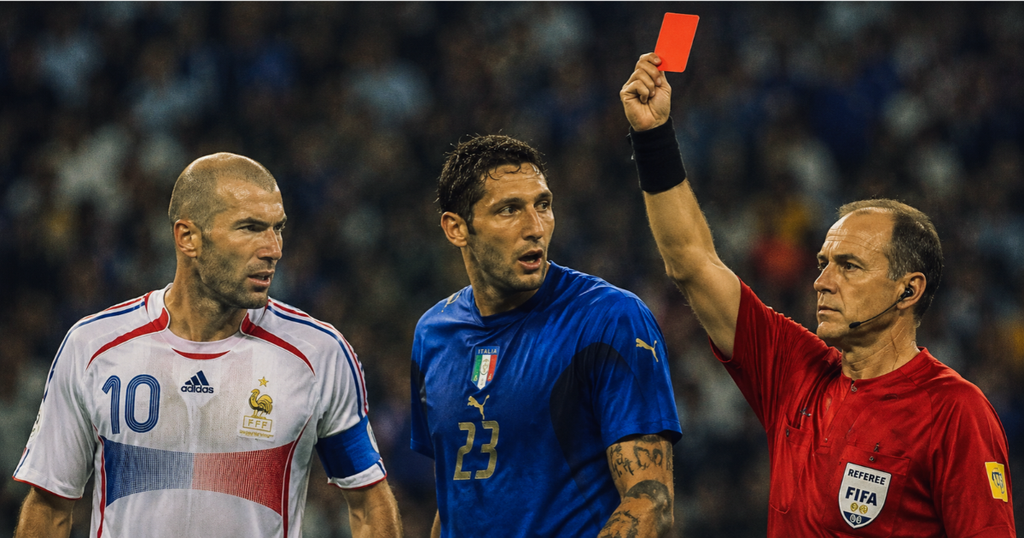
Zinedine Zidane’s headbutt on Marco Materazzi in the 2006 FIFA World Cup final took a split second and changed the match. The French captain was sent off in extra time, and France lost the final on penalties.
A yellow card is a formal caution. The player stays on the pitch, but a second yellow means an automatic red. A red card is a dismissal, and the team plays on with one fewer player.
Cards aren’t only for violence. Reckless tackles, dissent, time-wasting and denying an obvious goal-scoring opportunity can all get a player booked or sent off.
Below, you’ll find what earns a yellow, what earns a straight red, how a second booking differs from a direct red, how suspensions work and how referees make the call. After that come VAR reviews, famous sending-offs and the 2026/27 rule changes, including when video officials can now review a second yellow.
A referee’s pocket holds the power to change a match in an instant. Know how each card works because once it comes out, the game changes.
Key Takeaways
- A yellow card is a caution, and the player stays on. A red card means a player is sent off. The team cannot replace him.
- Two yellow cards in one match produce a red card.
- Red card bans depend on the offence and the competition. No single number applies everywhere.
- Since 1 July 2026, VAR can review a red card that came from a clearly incorrect second yellow.
- A team needs at least seven players to start or continue a match.
What Does a Yellow Card in Football Mean?
A yellow card is a formal caution. The referee shows it when a player commits a cautionable offence. Examples include a reckless tackle, dissent, or time-wasting. The player stays on the pitch, but the referee records the booking. A second caution in the same match brings a red card.
Yellow cards in football serve as warnings that carry significant consequences. The booked player plays on, yet he now walks a tightrope. Tackles get softer. Managers often replace a booked defender before he picks up a second yellow. And each booking also counts toward suspension totals later in the season.
What Does a Red Card Mean in Football?
A red card means a player is sent off. The referee shows it for a serious offence or a second caution. The player must leave the field and its surrounding area, and his team can’t replace him. They play the rest of the match with ten players, or fewer.
A straight red card in football needs no earlier caution. Serious foul play can trigger one. So can violent conduct or denying a clear goal. The impact is immediate because the shorthanded side must defend more and attack less.
One exception exists before kick-off. A player sent off after the team list is submitted can be replaced by a named substitute.
Why Do Players Receive Yellow Cards?
Law 12 of the Laws of the Game lists cautionable offenses.
The International Football Association Board (IFAB) wrote it. Most yellow cards in football come from a short list, and these yellow cards in football rules explain nearly every booking.
- Reckless challenges. The player acts with disregard for the danger to an opponent.
- Unsporting behaviour. This covers simulation, tactical fouls that stop promising attacks, verbal distractions, and provocative celebrations. Handling the ball in an attempt to score also lands here.
- Dissent. Arguing with the referee, or reacting with an offensive gesture, earns a booking.
- Delaying the restart. Booting the ball away or dawdling at a throw-in or free kick are typical examples.
- Persistent offences. A string of fouls can earn a caution even when no single foul deserves one. The Law sets no fixed number.
- Entering or leaving without permission. A player who steps on or off the pitch without the referee’s nod is cautioned.
- Other breaches. Failing to retreat the required distance at a restart is one. Excessive use of the TV screen signal is another.
Why Do Players Receive Red Cards?
Red cards in football are rarer than bookings. Referees show a straight red for the offences below, and a second caution adds one more route.
- Serious foul play. A challenge for the ball that uses excessive force or endangers an opponent’s safety.
- Violent conduct. Using, or attempting to use, excessive force when not contesting the ball. A punch, a headbutt or a kick away from play all qualify.
- Denying a goal or an obvious goal-scoring opportunity (DOGSO). Covered in full below.
- Spitting or biting. The target can be an opponent, an official or anyone else.
- Offensive, insulting or abusive language or gestures. Discriminatory abuse sits here.
- A second yellow card. Two cautions in one match end in a dismissal.
The line between the first two is simple. Serious foul play happens during a contest for the ball. Violent conduct happens away from one.
Careless, Reckless or Excessive Force? How Referees Decide
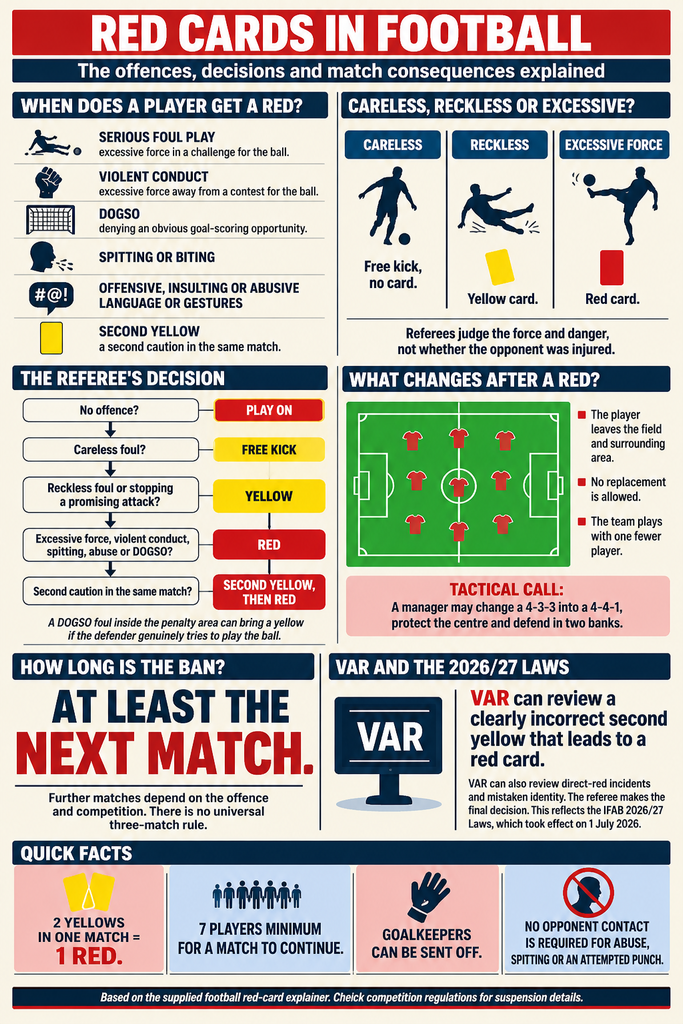
Referees judge the force and the danger, not the result. A careless foul brings a free kick and no card. A reckless one brings a yellow. Excessive force that endangers an opponent brings a red. The location, the speed and the match situation sharpen that call.
| Challenge | Meaning in the Law | Disciplinary response |
|---|---|---|
| Careless | A lack of attention or consideration | Free kick or penalty, no card required |
| Reckless | Disregard for the danger to an opponent | Yellow card |
| Excessive force | Force beyond what is necessary, endangering safety | Red card |
Three illustrative situations show the gap. These are invented examples, not real incidents.
- No card. A midfielder slides in a half-second late and clips an opponent’s ankle at low speed. The contact is clumsy, not dangerous. Free kick.
- Yellow card. A defender launches into a tackle from the side, eyes off the ball. The opponent skips clear, but the danger was real. Reckless, so a booking.
- Red card. A defender lunges straight-legged at knee height at full pace. The opponent’s safety is at stake, whether or not he is hurt. Serious foul play.
The same thought process works as a quick flowchart.
What Happens After Two Yellow Cards in One Match?
Two yellow cards in one match mean dismissal. The referee shows the second yellow, then a red. The player leaves and can’t be replaced. His team plays the rest of the match a player short, exactly as after a straight red.
A 2 yellow card dismissal in football carries the same on-pitch cost as a direct red. The difference lies in the route and the paperwork. The table below sets them side by side.
| Feature | Direct red | Second yellow |
|---|---|---|
| Previous caution | Not required | Required |
| Offence | Sending-off offence | Second cautionable offence |
| Dismissal | Immediate | After the second caution |
| Player leaves the pitch | Yes | Yes |
| Replacement allowed | No | No |
| Typical ban | Depends on offence | Usually one match |
What Happens to a Team After a Red Card?
The numbers tell only half the story. A red card rewires how a side plays.
Immediate consequences
The player leaves. The team continues with one fewer player and can’t bring on a replacement.
Tactical consequences
Space opens everywhere. The remaining players cover more ground, so fatigue builds faster. Pressing fades, the defensive line drops and attacking options shrink.
How managers respond
Picture a side in a 4-3-3 that loses a central midfielder. The manager often sacrifices a forward, drops the front three to a lone striker and builds two compact banks of four. The 4-3-3 becomes a 4-4-1. The aim is to protect the middle and make the opponent pass around a low block.
Can a Goalkeeper Receive a Yellow or Red Card?
Yes. A goalkeeper follows the same disciplinary rules as an outfield player. He can be booked for a reckless challenge or time-wasting. He can be sent off for violent conduct or for denying a goal outside his penalty area.
A goalkeeper owns their penalty area. Inside it, they can pick up the ball with their hands, with one big exception: the back-pass rule. If a teammate deliberately kicks the ball to the keeper, or throws it in directly to them, the keeper can’t handle it.
Break that rule and the referee awards an indirect free kick to the opposition. If the referee judges the play to be cynical or a deliberate trick to get around the rule, a yellow card can follow. When a keeper is sent off, the manager normally removes an outfield player to bring on the reserve keeper, or an outfield player pulls on the gloves.
Can a Player Receive a Red Card Without Touching an Opponent?
Yes. Plenty of red card rules don’t require contact at all.
- Abusive or offensive language. Words and gestures can be enough.
- Deliberate handball. Using a hand to stop a goal or an obvious scoring chance earns a straight red.
- Spitting and biting. The act itself is the offence.
- Violent conduct. An attempted punch that misses still counts.
How Does Yellow Card Accumulation Work?
Yellow card accumulation means bookings from different matches add up to a ban. A competition sets the threshold, and a player who reaches it misses a match. A second yellow within one game is separate and ends in a red card.
Domestic leagues set their own limits. In the Premier League, for example, five bookings before a set point in the season triggers a one-match ban, and later thresholds are higher. Different competitions pick different numbers, so always check the regulations.
At the 2026 World Cup, two yellow cards in separate matches bring a one-match suspension. Cards are wiped after the group stage and again after the quarter-finals. That reset stops a caution from week one from keeping a star out of a semi-final or the final.
How Many Matches Does a Red Card Ban Last?
A red card means an automatic one-match ban at minimum. For serious incidents, disciplinary panels can add games or fines. Straight reds draw extra punishment more often than second-yellow dismissals, which usually cost one match.
Exact penalties vary by competition: the FA, for example, adds a game for each repeat red in a season. Violent conduct, spitting, and biting often draw longer bans. No universal three-match rule exists.
Search “red card in football how many match ban” and answers range from one match to many months. In English football, for example, a DOGSO dismissal usually costs one match. Serious foul play or violent conduct typically costs three. A second yellow card means a sending-off, and most competitions add an automatic one-match ban.
The red card in a football match ban begins at the next fixture. A disciplinary committee can lengthen it for extreme cases. FIFA also carries unserved tournament suspensions over to a team’s next official match.
Can a Red Card Be Overturned After a Match?
Yes, in some cases. Governing bodies run post-match reviews. A club can claim wrongful dismissal, and a panel can rescind the card if it finds the referee erred. A case of mistaken identity gets corrected the same way.
Overturning a card and reducing a ban are two separate things. A panel can cancel the dismissal entirely, or it can confirm the red and still adjust the length of the suspension. Rules differ by competition, so appeal windows and standards vary.
What Is DOGSO in Football?
DOGSO stands for denying an obvious goal-scoring opportunity. A player who commits a foul or deliberate handball that stops one is usually sent off. Referees weigh four factors before deciding.
- The distance between the offence and the goal.
- The general direction of play.
- The likelihood of keeping or gaining control of the ball.
- The location and number of defenders and attackers.
Location changes the punishment. Outside the penalty area, a DOGSO foul earns a red card. Inside it, a defender who genuinely tries to play the ball is cautioned, because the penalty already restores the chance. Holding, pulling or pushing with no real attempt at the ball still means a red.
Can VAR Overturn Yellow and Red Cards?
VAR doesn’t review ordinary yellow cards. It can step in on direct red cards and, from 2026/27, on a red that came from a clearly incorrect second yellow. It can also fix mistaken identity. The referee always makes the final decision.
- Yellow card. Not reviewable, except where the wrong player is cautioned for someone else’s offence.
- Second yellow. A red caused by a clearly incorrect second caution is now reviewable.
- Direct red. VAR checks for a clear and obvious error, and the referee can watch the pitchside monitor.
- Mistaken identity. VAR can step in when a referee cards the wrong player, but only to fix the identity. It checks who committed the offence the referee penalised, not whether that offence deserved a card. The original decision stands.
- Final decision. The referee decides. VAR only advises.
VAR does not review yellow cards. The exception is a second caution that sends a player off. Since the 2026/27 Laws of the Game took effect on 1 July 2026, the video assistant referee can flag a red card that stems from a clearly incorrect second yellow, as long as the competition has adopted the protocol.
A first yellow is reviewable only in a mistaken-identity case, when the wrong player was booked. VAR cannot create a second yellow the referee never showed, and it stays out of anything that is merely debatable. Only the referee can order a review, and only the referee decides whether the card stands or is cancelled.
Can Managers, Coaches and Substitutes Receive Cards?
Yes. Cards apply well beyond the starting eleven.
- Managers and head coaches. Dissent, leaving the technical area or entering the pitch can bring a caution. A sending-off follows a second caution or a serious offence, and the manager must leave the technical area and surrounding space.
- Assistant coaches and team officials. The same logic applies to misconduct, offensive behaviour or interfering with play.
- Substitutes and substituted players. They can be cautioned or sent off from the bench. A dismissed substitute can’t be replaced, so the team simply loses a bench option.
What Happens If a Team Has Fewer Than Seven Players?
Law 3 states that a match may not start or continue if either team has fewer than seven players. If a team drops below seven players because someone deliberately walks off the field, the referee doesn’t have to stop play. Advantage can run.
But once the ball goes out of play, the match can’t restart unless that team is back to seven. Temporary dismissals and the new time-limited substitution and off-field treatment protocols are the exceptions. Any result or further sanction comes from the competition regulations.
Competition rules then decide what comes next, usually abandonment and a result awarded to the opponent. A player who refuses to leave after a red card changes nothing about the dismissal. The referee holds authority, can delay the restart or abandon the game, and the disciplinary body will deal with the player afterwards.
What Are the New Football Card Rules for 2026/27?
The 2026/27 Laws took effect on 1 July 2026. Some changes are compulsory wherever the Laws apply. Others are optional, so a league or tournament must choose to adopt them.
| Rule change | What it means | Status |
|---|---|---|
| VAR review of a red card from a clearly incorrect second yellow | VAR can review and correct a sending-off that resulted from a clearly incorrect second caution. | Compulsory where VAR is used |
| VAR review of mistaken identity | VAR can correct a yellow or red card shown to the wrong player when another player committed the offence, including a player from either team. | Compulsory where VAR is used |
| No sanction for DOGSO when advantage leads to a goal | The offender receives neither a yellow nor a red card for the DOGSO offence if the attacking team scores after the referee plays advantage. | Law change |
| “Attackers” added to DOGSO factors | Referees now consider the location and number of attackers, as well as defenders, when assessing an obvious goal-scoring opportunity. | Law change |
| Automatic caution removed for penalty kicker | The kicker is no longer automatically cautioned solely because the goalkeeper and kicker offend at the same time. | Law change |
| Ten seconds to leave when substituted | A player must leave within 10 seconds. If not, the substitute cannot enter until the first stoppage after one minute of play has elapsed following the restart. | Law change |
| Red card for leaving the pitch in protest | A player who leaves the field in protest at a referee’s decision, or a team official who instructs or encourages players to leave, can receive a red card. | Competition option |
| Red card for covering the mouth | A player, substitute or substituted player can be sent off for covering their mouth while communicating with an opponent in a provocative, derisory or inflammatory manner or situation. | Competition option |
FIFA first described the last two as items for consultation in February 2026. IFAB then approved them as competition options on 28 April 2026.
Who Invented Yellow and Red Cards in Football?
English referee Ken Aston invented them. He had refereed the violent 1962 World Cup match between Chile and Italy, known as the Battle of Santiago. After the 1966 England v Argentina match, a confused booking left players and fans unsure who had been cautioned.
Aston then stopped at a traffic light on Kensington High Street. Amber and red, he realised, could speak across any language. The cards debuted at the 1970 World Cup.
Famous Yellow and Red Card Incidents in Football History
| Match | Offence | Decision | Consequence |
|---|---|---|---|
| England v Argentina, 1998 World Cup | David Beckham flicked out at Diego Simeone | Red card, early in the second half | England played on with ten and lost the shootout 4-3 after a 2-2 draw |
| Italy v France, 2006 World Cup final | Zinedine Zidane headbutted Marco Materazzi | Red card in extra time | Italy won 5-3 on penalties after a 1-1 draw |
| Portugal v Netherlands, 2006 World Cup | A bruising, foul-filled last-16 tie | 16 yellows and 4 reds, two players sent off per side | Portugal won 1-0 in a record-setting match |
| Uruguay v Ghana, 2010 World Cup | Luis Suárez handled on the goal line | Red card and a penalty | Ghana missed the penalty, and Uruguay won 4-2 on penalties |
| Argentina v Netherlands, 2022 World Cup | Heated clashes all night | 18 yellow cards, a World Cup record, and a red for Denzel Dumfries after a second booking | Argentina won on penalties |
Difference Between Yellow Cards and Red Cards in Football
| Area | Yellow card | Red card |
|---|---|---|
| Meaning | Formal caution | Sending-off |
| Severity | Lower | Higher |
| Player can continue | Yes | No |
| Immediate consequence | Booking recorded | Player leaves the field and surrounding area |
| Substitution | Not affected | Team can’t replace the player |
| Accumulation | Counts toward a league or tournament total | Not applicable |
| Suspension | Only when totals are reached | Automatic ban at minimum |
| Match consequence | Player plays more cautiously | Team plays shorthanded |
What Comes Next for Football’s Disciplinary Rules
Football disciplinary rules rarely stand still. This season’s best signal is the pair of competition options on protest walk-offs and covered-mouth provocation. If leagues and tournaments adopt them widely, the next set of Laws may make them mandatory.
For now, the core logic holds. Careless fouls cost a free kick. Reckless ones cost a booking. Excessive force costs the player his place on the pitch. The real question for 2027 is whether VAR’s growing reach into card decisions will make referees braver or merely slower.
FAQ
What does yellow card in football mean?
A yellow card is an official caution. The referee shows it for a cautionable offence such as a reckless challenge, dissent or time-wasting. The player stays on the pitch, but the booking is recorded. Another caution in the same match brings a red card.
What does red card mean in football?
A red card is a sending-off. The player must leave the field and its surrounding area immediately. His team can’t replace him and plays the rest of the match with fewer players. A ban usually follows, and its length depends on the offence and the competition.
How many yellow cards equal a red card?
Two yellow cards in the same match equal a red card. The referee shows the second yellow and then a red, and the player is dismissed. Yellow cards collected across different matches don’t create a red. They can trigger a suspension instead.
Can a player receive two red cards in one match?
No. A player is dismissed once and then leaves the pitch. A second yellow followed by a red counts as a single dismissal. Any misconduct after that is reported by the referee, and the disciplinary body decides on further punishment after the match.
Can a referee show a yellow card after the final whistle?
Yes. A referee’s authority continues until he leaves the field of play after the match. He can still caution or send off a player for misconduct at that point, which is what happened to Denzel Dumfries after the 2022 quarter-final shootout.
Can a goalkeeper receive a red card?
Yes. A goalkeeper can be sent off for violent conduct, serious foul play or denying an obvious goal-scoring opportunity, such as a foul or handball outside his penalty area. The manager then usually replaces an outfield player with the reserve keeper.
Can a substitute receive a red card?
Yes. A substitute or substituted player can be cautioned or sent off for misconduct, even from the bench. The team can’t replace him, so it loses that option. A dismissal also leaves the player facing a disciplinary process after the match.
Can a manager receive a red card?
Yes. A manager can be cautioned for dissent or for leaving the technical area, and sent off after a second caution or a serious offence. The manager must then leave the technical area and its immediate surroundings and can’t instruct the team from the touchline.
Can VAR overturn a yellow card?
Not in ordinary cases. VAR doesn’t review a yellow card for being too harsh or too lenient. The exception is mistaken identity, where VAR can confirm that the wrong player was cautioned. The referee always makes the final decision.
Can VAR review a second yellow card?
Yes, since the 2026/27 Laws. VAR can review a red card that came from a clearly incorrect second yellow. The video referee looks for a clear error, and the referee makes the final call, sometimes after viewing the pitchside monitor.
How many matches does a red card suspension last?
It depends. A red card means a ban from the next match at minimum. Violent conduct, spitting or biting often bring longer bans. The red card in football match ban differs between leagues, so no single number applies everywhere.
Do yellow cards reset during a tournament?
It depends on the tournament. At the 2026 World Cup, cautions were wiped after the group stage and again after the quarter-finals. Most domestic leagues don’t reset cards mid-season, though some clear them at set points in the campaign.
Can a player receive a red card without touching an opponent?
Yes. Abusive language, spitting, deliberate handball to stop a goal and an attempted punch that misses all earn a red card. The Law punishes the offence itself, so physical contact with an opponent isn’t a requirement for a sending-off.
Can a team replace a player after a red card?
No. A team plays on without the dismissed player and can’t bring a substitute into his place. The only exception comes before kick-off, when a player sent off after the team list is submitted can be replaced by a named substitute.
How many players must a football team have to continue a match?
Seven. Law 3 states that a match can’t start or continue if either team has fewer than seven players. Competition rules decide whether a match is abandoned or a result is awarded when a team drops below that number.
If you enjoy reading it, be sure to follow Sports Dribble on Facebook, Instagram, and Twitter.

Krishanu Das is the founder and lead writer of Sports Dribble. With more than five years of experience in sports writing, he specializes in creating well-researched guides, sports rules, player rankings, tournament explainers, and match analysis across cricket, football, basketball, tennis, volleyball, and many other sports.
Although he works as an accountant by profession, sports have always been his lifelong interest. That passion inspired him to build Sports Dribble, where he focuses on publishing accurate, easy-to-understand, and regularly updated content for sports fans around the world.
Before every article is published, Krishanu researches official rulebooks, governing bodies, tournament regulations, trusted statistics, and reliable sources to ensure readers receive factual and up-to-date information. His goal is simple: help every reader understand the game with clear explanations, practical insights, and information they can trust.