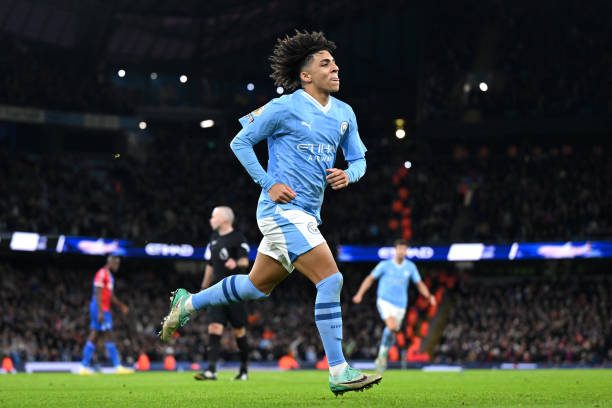
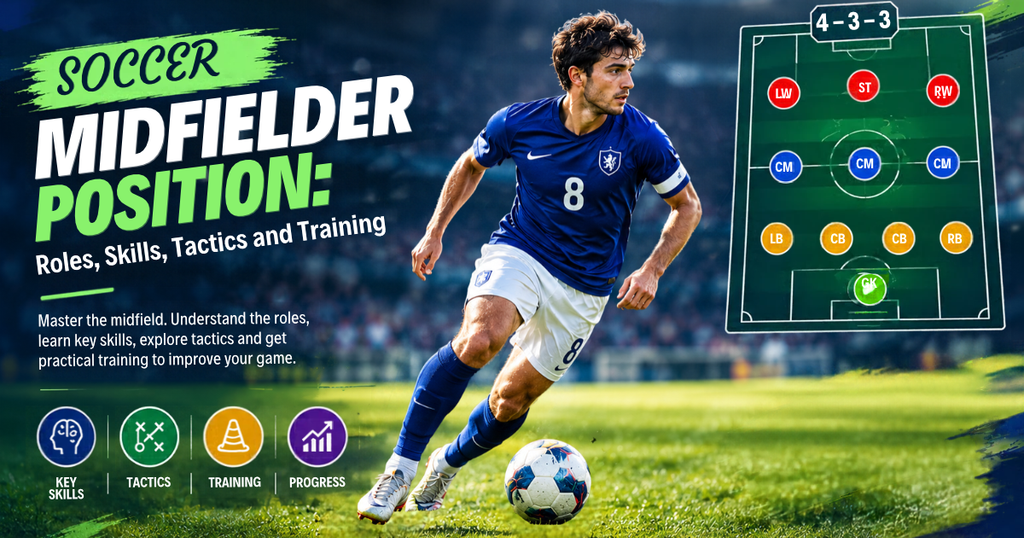
The soccer midfielder position connects defense and attack, acting as the engine of the team to control the rhythm and flow of the match.
Midfielders win the ball, find open teammates, create chances and help protect the goal. But good midfield play is about more than passing.
A midfielder must know when to turn, when to move forward, when to keep the ball and when to defend. The No. 6 protects the back line, the No. 8 links both ends of the field, and the No. 10 creates chances near goal. Their jobs change with the formation, the opponent and the flow of the game.
What Does a Soccer Midfielder Roles?
A midfielder plays between the defenders and forwards. The player helps the team keep possession, move the ball forward and stop the other team from attacking.
The main jobs of a soccer midfielder are to:
- Build attacks: Move the ball from defense toward the forwards.
- Keep possession: Find open teammates and avoid risky passes.
- Win the ball: Intercept passes, tackle and recover loose balls.
- Create chances: Find passes that help teammates get closer to goal.
- Protect the defense: Cover open space and block dangerous passes.
- Support teammates: Move into useful spaces before the ball arrives.
- React to turnovers: Press or recover when the team loses possession.
Imagine a center back passing to a midfielder. An opponent closes in from behind. The midfielder checks over a shoulder before receiving, spots an open teammate and plays a safe pass.
That small action can help the team escape pressure and start an attack.
Midfielders also manage transitions. A transition is the moment a team changes from attack to defense or defense to attack. A quick reaction after winning or losing the ball can stop a counterattack or create a scoring chance.
What Are the Main Midfielder Positions in Soccer?
The main soccer midfielder positions are defensive midfielder, central midfielder, attacking midfielder and wide midfielder. Each has a different focus, but their duties often overlap.
| Position | Common number | Main responsibility |
|---|---|---|
| Defensive midfielder | No. 6 | Protect the defense and start attacks |
| Central midfielder | No. 8 | Connect defense and attack |
| Attacking midfielder | No. 10 | Create chances near the forwards |
| Wide midfielder | Often No. 7 or 11 in some systems | Support play on the sides and help defend |
These numbers describe traditional roles, not fixed rules about jersey numbers. A coach may change a player’s duties based on the formation and the team’s plan.
Defensive Midfielder: The No. 6
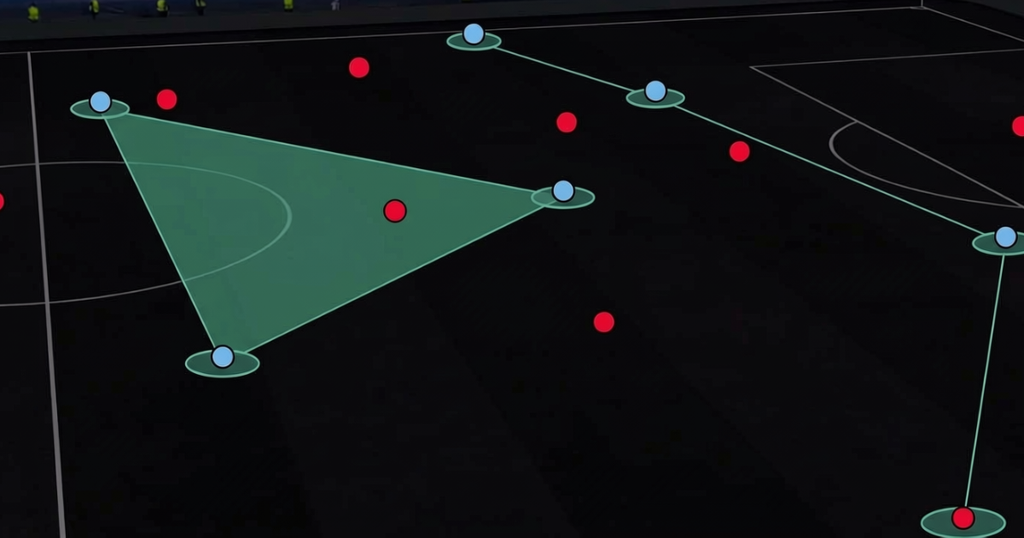
The defensive midfielder position sits in front of the center backs in many formations. The No. 6 protects the middle, blocks passes into dangerous areas and helps start attacks from deep.
The main responsibilities include:
- Protecting the space in front of the defense.
- Intercepting passes and making well-timed tackles.
- Covering when a fullback moves forward.
- Giving defenders a safe passing option.
- Moving the ball forward when a clear opportunity appears.
Match example: An opponent tries to pass through the middle. The No. 6 reads the play, moves into the passing lane and wins the ball. The midfielder then passes to an open teammate.
The key is positioning. A No. 6 should not chase every opponent. Moving too far from the center can leave a dangerous gap behind.
Skills to develop: Scanning, positioning, interceptions, tackling, ball control and passing under pressure.
Central Midfielder: The No. 8
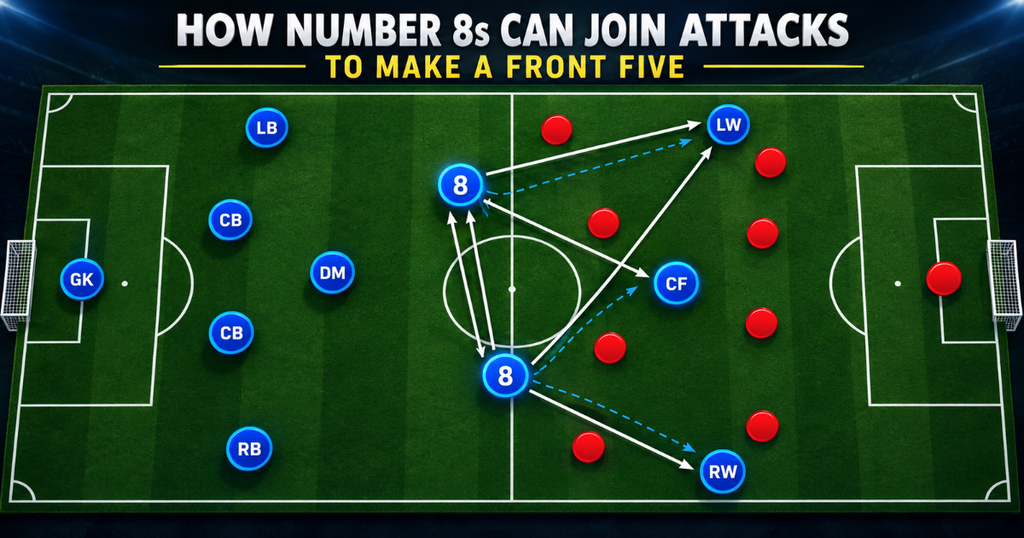
The central midfielder position connects defense and attack. The No. 8 helps keep possession, moves the ball forward and supports teammates in both halves.
A box-to-box midfielder is a type of central midfielder who regularly helps near both penalty areas.
The main responsibilities include:
- Receiving passes from defenders.
- Finding space to turn or pass forward.
- Supporting attacking runs.
- Pressing opponents when the team loses the ball.
- Recovering to help defend.
Match example: The No. 8 receives a pass from a center back. After scanning, the midfielder turns into space and passes to a forward. If the forward pass is blocked, a short pass to another midfielder can keep the attack moving.
A good No. 8 knows when to join the attack and when to hold position. If both central midfielders run forward at once, the team may struggle to stop a counterattack.
Skills to develop: Passing, first touch, movement, awareness, stamina and decision-making.
Attacking Midfielder: The No. 10
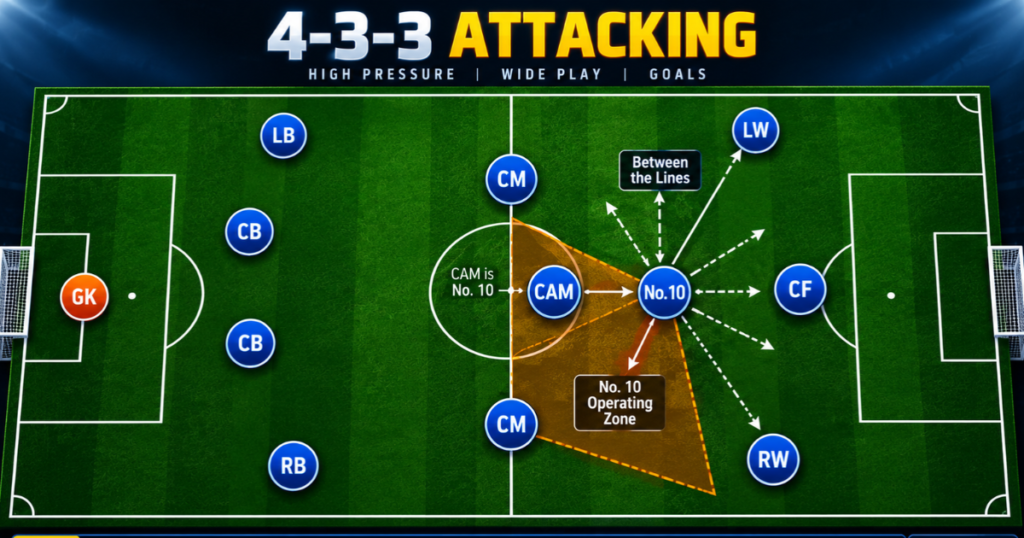
The attacking midfielder position is closer to the forwards. The No. 10 looks for space between the opposing midfield and defense.
The main responsibilities include:
- Finding space behind the opposing midfield.
- Playing passes that split defenders.
- Creating chances for teammates.
- Dribbling into open space.
- Shooting when a good opportunity appears.
Match example: A forward runs behind the defense. The No. 10 spots the run and plays a through ball into space. The forward can then move toward goal.
The No. 10 should not force every difficult pass. A short pass, a quick turn or a simple move can open a better chance a few seconds later.
Skills to develop: Vision, close control, first touch, creative passing and quick decisions.
Wide Midfielder
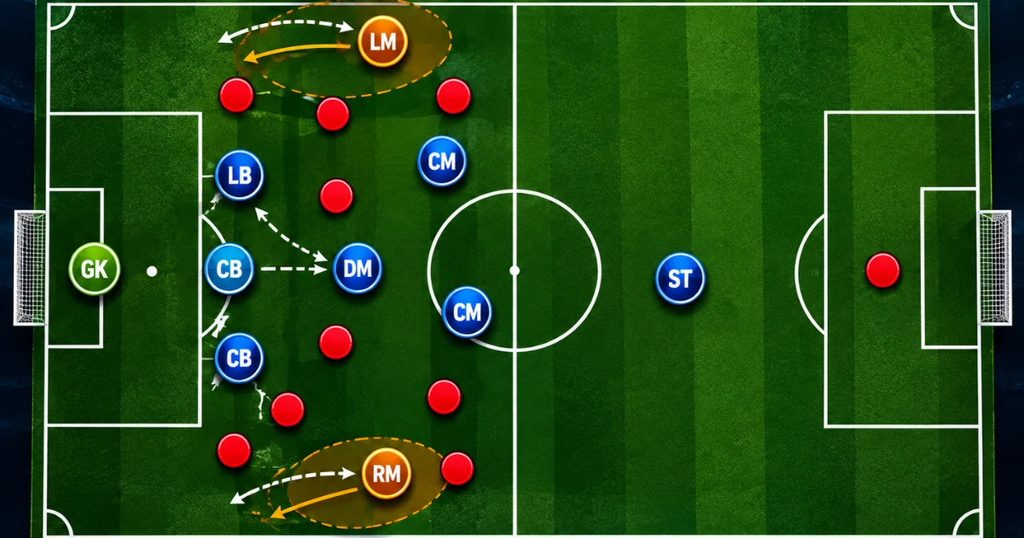
A wide midfielder plays on the left or right side of the field. The player gives teammates a passing option near the sideline, supports attacks and helps the fullback defend.
Wide midfielders often need to:
- Create space near the sideline.
- Cross or pass into the penalty area.
- Move inside to help central play.
- Track opponents on defense.
- Support the team during transitions.
A wide midfielder is not always the same as a winger. Wide midfielders often have more defensive duties, while wingers usually play higher up the field. The exact role depends on the formation and the coach’s plan.
No. 6 vs. No. 8 vs. No. 10: What’s the Difference?
The main difference is where each midfielder works and what the team needs from that player.
| Trait | No. 6 | No. 8 | No. 10 |
|---|---|---|---|
| Starting area | In front of the defense | Central midfield | Behind the forwards |
| Main focus | Protect and build | Connect both ends | Create chances |
| Key skill | Positioning | Movement and passing | Vision and creativity |
| Defensive work | Protects central space | Presses and recovers | Presses and blocks passing lanes |
| Attacking work | Starts attacks | Supports forward runs | Creates chances and may score |
These are typical roles, not strict boundaries. A No. 6 can break a defensive line with a forward pass. A No. 8 can score goals. And No. 10 can help win the ball back.
The best midfielders understand their own role and adjust to what the team needs.
How Midfielders Fit Into Soccer Formations
A formation shows the team’s basic shape. Players move as the ball moves, so their positions during a match may look different from the starting formation.
The 4-3-3 Formation
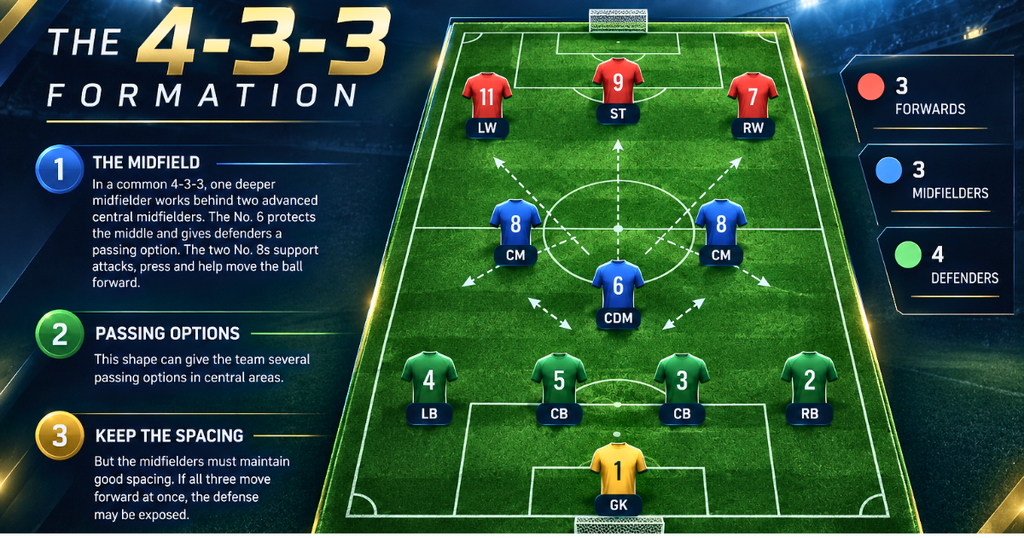
A 4-3-3 uses four defenders, three midfielders and three forwards.
In a common 4-3-3, one deeper midfielder works behind two advanced central midfielders. The No. 6 protects the middle and gives defenders a passing option. The two No. 8s support attacks, press and help move the ball forward.
This shape can give the team several passing options in central areas. But the midfielders must maintain good spacing. If all three move forward at once, the defense may be exposed.
The 4-2-3-1 Formation
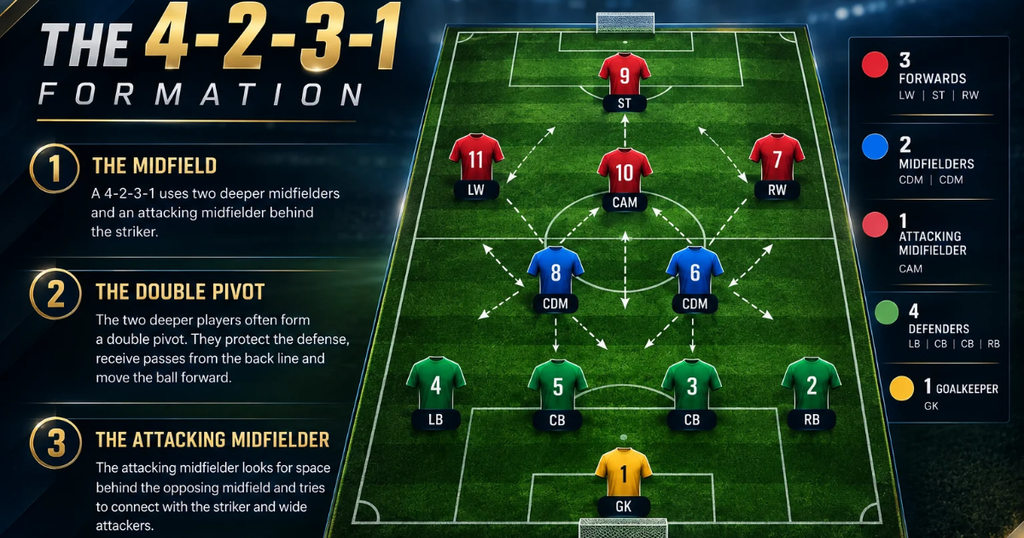
A 4-2-3-1 uses two deeper midfielders and an attacking midfielder behind the striker.
The two deeper players often form a double pivot. They protect the defense, receive passes from the back line and move the ball forward.
The attacking midfielder looks for space behind the opposing midfield and tries to connect with the striker and wide attackers.
The 4-4-2 Formation
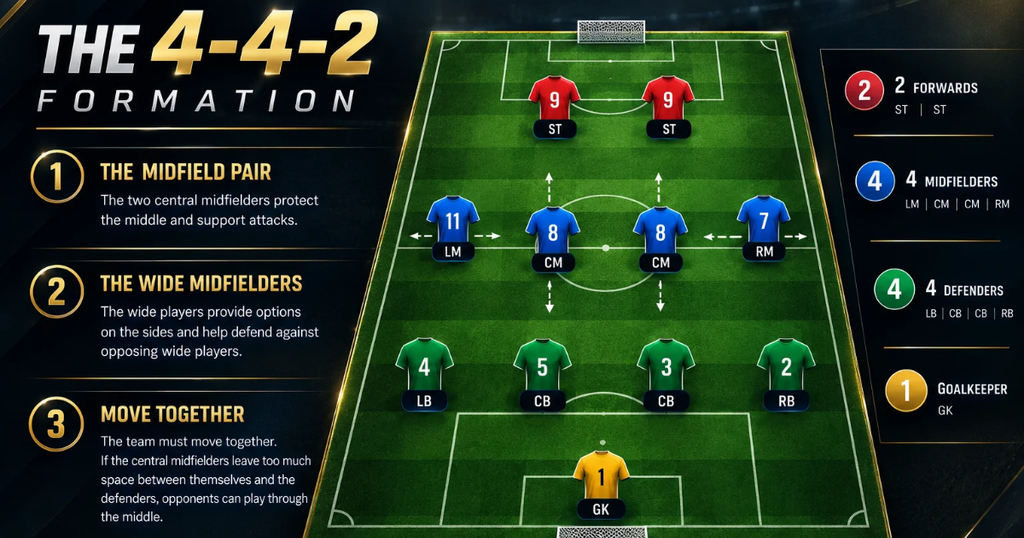
A 4-4-2 usually has two central midfielders and two wide midfielders.
The central pair protects the middle and supports attacks. The wide players provide options on the sides and help defend against opposing wide players.
The team must move together. If the central midfielders leave too much space between themselves and the defenders, opponents can play through the middle.
How to Make Better Decisions as a Soccer Midfielder
Good midfielders do not make the same pass every time. They scan the field, read pressure and choose the action that helps the team most.
| What you see | What to consider |
|---|---|
| Open space ahead | Turn, carry the ball or pass forward |
| An opponent closing from behind | Check your shoulder and find a safe next action |
| A forward running behind the defense | Look for a through ball if the lane is open |
| No safe forward pass | Keep possession and find another angle |
| A teammate moving forward | Support the run or cover the space behind |
| Your team loses the ball | Press if you have support; otherwise recover |
These are choices, not automatic rules. A forward pass is useful only when it has a reasonable chance of reaching a teammate. Keeping possession may be the smarter choice when the risk is too high.
A Tactical Example: One Decision Can Open the Field
Imagine your team is building an attack from the back in a 4-3-3.
- The center back has the ball. The No. 6 moves into a clear passing lane.
- The No. 6 scans before receiving. The player sees an opponent approaching from behind and spots the right No. 8 in space.
- The No. 6 receives on an open body angle. This makes it easier to see the field instead of facing only the passer.
- The passing lane is clear. The No. 6 plays forward to the No. 8, breaking past the opposing forwards.
- The No. 8 looks for the next action. If a forward is open, the player can pass ahead. If the defense closes the lane, the No. 8 can protect the ball and recycle possession.
Now consider the alternative. If the No. 6 receives without scanning and forces a pass into a blocked lane, the opponent may win the ball while the team is spread out.
The lesson is not that forward passes are always better. It is that scanning before receiving gives the midfielder more choices.
How to Play a Line-Breaking Pass
A line-breaking pass moves the ball past one or more opposing players or units. It can help a team move from defense into attack.
Before playing the pass, the midfielder should check three things:
- The lane: Can the ball reach the teammate without being intercepted?
- The receiver: Is the teammate ready and able to control the ball?
- The next action: Will the receiver have space or support after the pass?
If the answer is yes, the pass may help the team progress. If the lane is blocked, a sideways or backward pass can help the team find another opening.
Coaching point: Do not force a pass just because a teammate is ahead. Check the lane, the pressure on the receiver and the space available for the next action.
When to Keep the Ball Instead of Forcing an Attack
Sometimes the team needs a fast forward pass. At other times, it needs to slow down and keep possession.
If forward options are covered, move the ball sideways or backward. This can make the opponent shift and open a new passing lane.
Keeping possession is not passing without purpose. Each pass should help the team maintain control, move an opponent or create a better chance to attack.
How Midfielders Work Together
A midfield is a unit, not three separate players. In a common 4-3-3, the No. 6 and two No. 8s must create passing options while protecting the space around them.
The No. 6 Protects the Center
The No. 6 gives defenders a passing option and helps protect the middle when the advanced midfielders move forward. The player must read danger without following every opponent away from the central area.
The No. 8s Create Different Options
The two No. 8s should avoid moving into the same space at the same time. One can move closer to the ball while the other looks for space farther forward.
Their positions should change with the ball and the opponent. The aim is to give the player in possession more than one useful option.
The Team Covers the Space
When one midfielder advances, the others must recognize the space left behind. The No. 6 may hold position, or the other No. 8 may delay a forward run to help protect against a counterattack.
There is no rule that one player must always stay back. The team must judge the situation and maintain enough cover to respond if possession changes.
What Happens When a Midfielder Gets Pulled Out of Position?
Imagine an opposing midfielder receives the ball near the right sideline. Your No. 6 moves too far across to press, while both No. 8s move forward.
The center is now exposed. The opponent may pass into the space the No. 6 left behind.
To fix the problem:
- The nearest player pressures the ball when it is safe and useful.
- A teammate covers the space behind that player.
- Another midfielder protects the central passing lane.
- The team shifts together rather than leaving one player to defend several threats.
Pressure the ball without losing track of the space your team needs to protect.
A 45-Minute Soccer Midfielder Training Session
The following session is a practical starting point for players who already know basic passing and ball control. The timings are suggested coaching recommendations, not official standards. Adjust them to the players’ age, fitness, experience and available space.
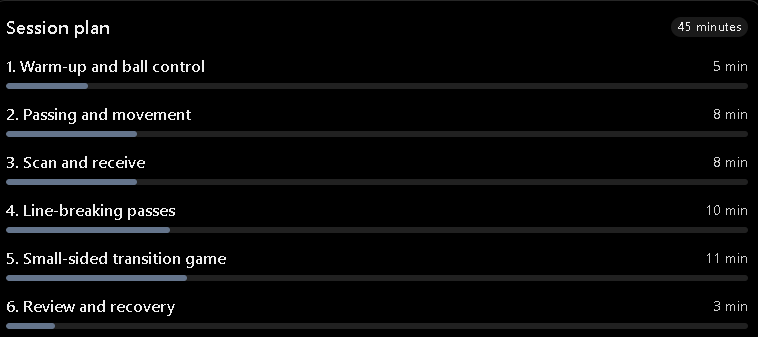
Drill 1: Passing and Movement
Time: 8 minutes
Players: 3–5, plus one ball per group.
Setup: Set up a small passing triangle with cones. Start about 5–10 yards apart, adjusting the distance to player ability.
Task: Pass to a teammate, then move to create a new passing angle. Use both feet where possible.
Progression: Add a third passing option or a passive defender.
Coaching cues: Pass accurately, move after passing and avoid standing behind another player.
Measure progress: Can players move into a useful position before the next pass?
Drill 2: Scan and Receive
Time: 8 minutes
Players: 3 per group.
Setup: One player passes, one receives, and one applies light pressure.
Task: The receiver scans before the ball arrives, checks the pressure and chooses whether to turn, pass or protect the ball.
Progression: Let the defender choose the side of pressure so the receiver must read the situation.
Coaching cues: Check your shoulder, open your body when possible and use the first touch to prepare the next action.
Measure progress: Does the player identify pressure before receiving rather than after controlling the ball?
Drill 3: Find a Line-Breaking Pass
Time: 10 minutes
Players: At least 5, with additional players rotating in.
Setup: Three players keep possession against two defenders. Place a target player or target zone beyond the defenders.
Task: The midfielders look for a safe pass through or around the defenders.
Progression: Allow active pressure. Add a touch limit only when players can control the ball and make sound decisions.
Coaching cues: Scan, create passing angles and avoid forcing the ball into a blocked lane.
Measure progress: Can the group recognize when to play forward and when to keep possession?
Drill 4: Small-Sided Transition Game
Time: 11 minutes
Players: Use small teams suited to the group size and available space.
Setup: Mark a playing area with a target goal or zone for each team.
Task: Play a small-sided game. When a team loses possession, the nearest player presses if support is available. Teammates cover passing lanes and recover into shape.
When a team wins the ball, players look forward first. If the forward pass is not safe, they keep possession and build again.
Progression: Give the team that wins the ball a chance to attack immediately.
Coaching cues: React quickly, communicate and protect the middle.
Measure progress: Does the team respond together when possession changes?
Drill 5: Review and Recovery
Time: 3 minutes
Walk, recover and review the session. Ask each player to name one good decision and one decision to improve.
Choose one clear goal for the next practice, such as scanning before receiving or recovering into position after a turnover.
How to Measure Your Progress as a Midfielder
Do not judge your game only by goals, assists or the number of passes you complete. Midfielders also help their teams through positioning, movement, defensive work and smart choices.
Use this simple checklist after a game or practice.
Midfielder Self-Check
After a game or practice, rate each skill honestly. This is a reflection tool, not a formal assessment.
This checklist helps you choose a practice focus. It cannot determine your best position on its own. A coach can also assess your technique, movement, understanding of the team’s tactics and response to pressure.
Which Midfielder Position Is Best for You?
The best midfielder position depends on your skills, interests and the team’s needs. No single trait decides where you should play.
Consider the No. 6 if you enjoy reading danger.
You may enjoy protecting the defense, winning the ball and helping your team build from deep. Practice scanning, positioning and safe forward passing.
Consider the No. 8 if you enjoy helping everywhere.
You may enjoy connecting defense and attack, finding space and supporting both phases. Practice receiving under pressure, passing and timing your runs.
Consider the No. 10 if you enjoy creating chances.
You may enjoy finding gaps, playing forward passes and linking with the forwards. Practice close control, vision and decisions in tight spaces.
Consider wide midfield if you enjoy using the sides.
You may enjoy crossing, combining near the sideline and helping your fullback defend. Practice delivery, movement and tracking runners.
These are starting points, not strict rules. Young players can learn several roles as they develop. A coach can help them find a suitable position and choose skills to practice.
Common Midfielder Mistakes and How to Correct Them
- Watching the ball instead of scanning: Look around before the pass arrives. Identify the pressure and at least one useful next option.
- Forcing forward passes: Check whether the passing lane is open and whether the receiver can control the ball. Keep possession if the risk is too high.
- Standing still after passing: Move into a new space or change the passing angle to help the next player.
- Chasing the ball without support: Press when the team can cover the space behind you. If support is missing, recover into a useful defensive position.
- Sending every midfielder forward: Check the team’s balance before making a forward run. Someone must be ready to protect against a counterattack.
- Trying to solve every problem alone: Communicate, trust teammates and choose the action that gives the team the best chance of keeping possession or winning the ball back.
If you enjoy reading it, be sure to follow Sports Dribble on Facebook, Instagram, and Twitter.

Krishanu Das is the founder and lead writer of Sports Dribble. With more than five years of experience in sports writing, he specializes in creating well-researched guides, sports rules, player rankings, tournament explainers, and match analysis across cricket, football, basketball, tennis, volleyball, and many other sports.
Although he works as an accountant by profession, sports have always been his lifelong interest. That passion inspired him to build Sports Dribble, where he focuses on publishing accurate, easy-to-understand, and regularly updated content for sports fans around the world.
Before every article is published, Krishanu researches official rulebooks, governing bodies, tournament regulations, trusted statistics, and reliable sources to ensure readers receive factual and up-to-date information. His goal is simple: help every reader understand the game with clear explanations, practical insights, and information they can trust.