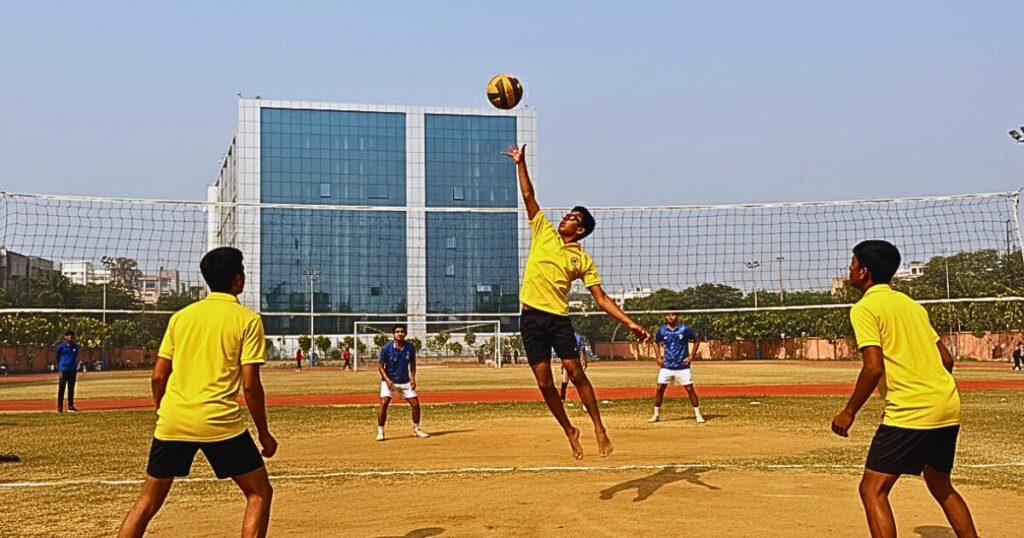
Throwball skills are the basic techniques used to serve, catch and return the ball during a match. The main fundamental skills are overhand service, side-arm service, two-hand catching, one-hand overhead return and side-arm return. Beginners should learn these skills first. Then they can work on throwing accuracy, footwork, court movement and team play.
Throwball is a team sport played across a net. Players catch the ball with both hands and return it with one hand. Good timing, control and quick movement help players keep the rally going. The Throwball Federation of India describes Throwball as a fast team sport played in schools, colleges and competitions.
This guide explains the main Throwball skills, techniques, drills, practice tips and simple tricks for beginners. It also gives short answers for students who need Throwball notes for Physical Education.
Key Takeaways
- The five main fundamental Throwball skills are overhand service, side-arm service, two-hand catching, one-hand overhead return and side-arm return.
- Catch the ball with both hands and control it before making the return.
- A legal return uses one hand and is released above the shoulder under the TFI rules.
- Beginners should learn control before trying to throw with more power.
- Wall catches, partner drills, target throws and service practice are simple ways to improve.
- Good footwork helps you reach the ball and get into a better position.
- Team communication helps players avoid confusion and open spaces on the court.
- PE students can use the skill explanations below for short-answer questions.
What Are the Fundamental Throwball Skills?
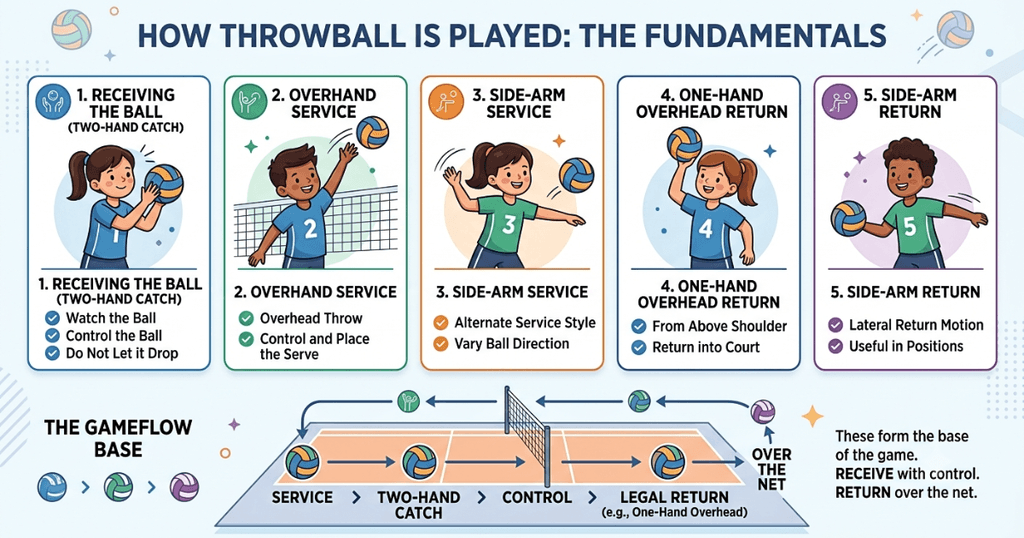
The main fundamental Throwball skills taught in Physical Education courses are overhand service, side-arm service, two-hand catching, one-hand overhead return and side-arm return.
These five skills form the base of the game. A player first needs to receive the ball with control. The player then uses a legal return to send it back over the net.
1. Two-Hand Catching
Two-hand catching is one of the first skills a beginner should learn.
Keep your eyes on the ball as it comes toward you. Bring both hands into a ready position. Catch the ball with both hands and keep it under control.
A good catch gives you time to prepare your return.
Simple tips:
- Watch the ball all the way.
- Keep both hands ready.
- Keep your body balanced.
- Do not let the ball hit the ground.
- Control the ball before you throw it.
2. Overhand Service
The service starts play.
In an overhand service, the player uses an overhead throwing action to send the ball over the net. The service should be controlled and aimed into the opponent’s court.
Do not focus only on power. A well-placed serve can be more useful than a hard serve.
Practice tip: Pick a target area on the other side of the court. Try to land the service near that area again and again.
3. Side-Arm Service
A side-arm service uses a side-arm throwing action.
It gives the server another way to change the direction and path of the ball. Beginners should first learn the basic movement before trying to add speed.
Keep the motion smooth. Aim at a clear target rather than simply throwing as hard as possible.
4. One-Hand Overhead Return
After catching the ball, a player returns it with one hand.
The one-hand overhead return is made from above the shoulder. The player should control the direction and release the ball within the time allowed by the rules.
The aim is simple: send the ball over the net and into a useful area of the opponent’s court.
5. Side-Arm Return
A side-arm return uses a side-arm motion to send the ball back.
It can give the player another way to change the direction of the return. It is useful when a side-arm action feels more natural for the position of the ball.
Start slowly. Learn the motion first. Add speed later.
How to Improve Throwball Skills
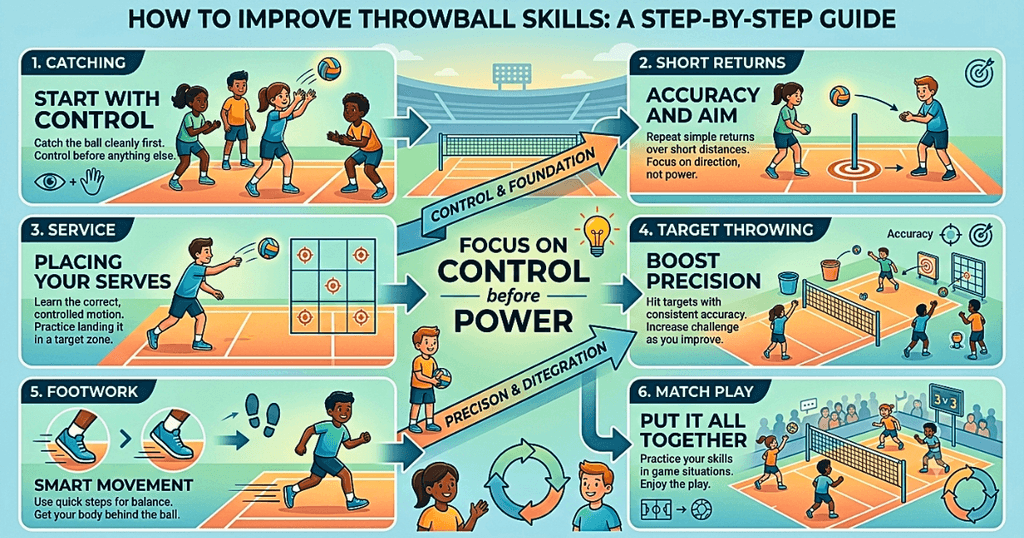
The best way to improve Throwball skills is to repeat simple movements with good control.
Do not try to learn everything at once.
Start with:
- Catching.
- Short returns.
- Service.
- Target throwing.
- Footwork.
- Match play.
Once these movements feel easy, increase the distance and speed.
Focus on Control Before Power
A beginner may try to throw the ball as hard as possible.
That is not the best place to start.
A controlled throw is easier to aim. It also helps you learn the correct movement.
First ask:
Can I catch the ball cleanly?
Then:
Can I return it where I want?
After that:
Can I do it faster?
This simple order makes practice easier.
How to Catch a Throwball
A clean catch starts with good body position.
Follow these steps:
Step 1: Watch the ball.
Step 2: Move toward the ball if needed.
Step 3: Keep both hands ready.
Step 4: Catch the ball with both hands.
Step 5: Keep your body balanced.
Step 6: Prepare for the return.
Under the TFI rules, the ball is received with both hands. The player must control the catch and then make the return according to the rules.
Common catching mistakes
- Looking away before the catch.
- Using one hand.
- Standing too stiff.
- Waiting for the ball instead of moving.
- Trying to catch a difficult ball with poor body position.
How to Throw a Throwball Correctly
A good Throwball return needs control, direction and timing.
After the catch, prepare the throwing arm. Use one hand for the return and aim at an open area of the opponent’s court.
Under the TFI rules, the return is made with one hand and from above the shoulder. The official rulebook also includes a time limit for the release.
Simple throwing steps
- Catch the ball with both hands.
- Get your body balanced.
- Choose your target.
- Bring the ball into the throwing position.
- Use one hand for the return.
- Release the ball above the shoulder.
- Follow through toward the target.
Do not worry about maximum power when you are learning.
Accuracy comes first.
Throwball Drills for Beginners
You do not need a full team to work on basic Throwball skills.
These simple drills can help beginners improve catching, throwing, timing and movement.
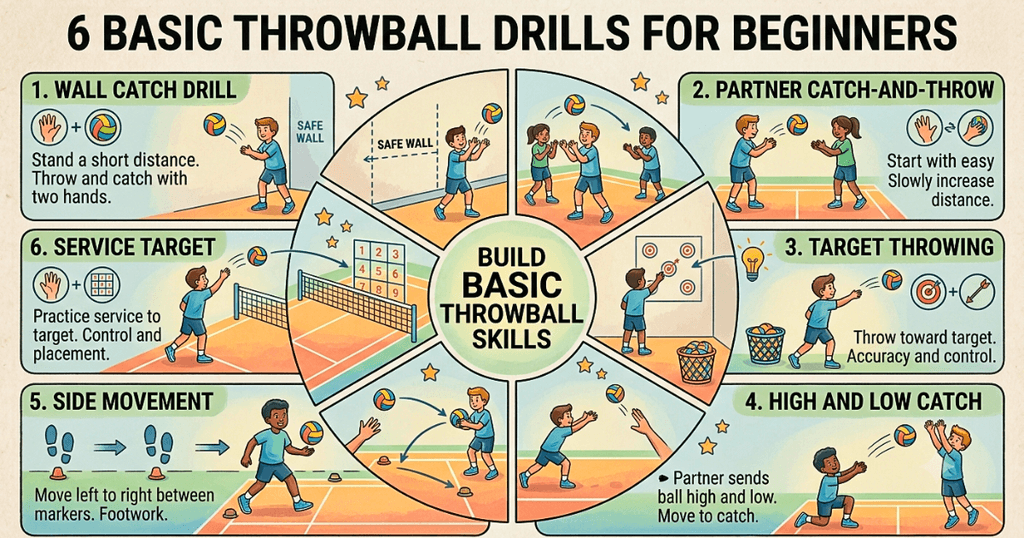
1. Wall Catch Drill
Stand a short distance from a safe wall.
Throw the ball toward the wall. Catch the rebound with both hands.
Start close to the wall. Move farther away when the drill becomes easy.
Works on: catching, timing and hand-eye coordination.
2. Partner Catch-and-Throw Drill
Stand a few steps away from a partner.
One player throws. The other catches with both hands and returns the ball.
Start with easy throws. Slowly increase the distance.
Works on: catching, throwing and timing.
3. Target Throwing Drill
Choose a safe target on a wall or court.
Try to throw the ball toward the target.
Change the target after several successful throws.
Works on: accuracy and control.
4. High and Low Catch Drill
Ask a partner to send the ball at different heights.
Try to move into position before catching it.
Works on: reaction time and movement.
5. Side Movement Drill
Move from left to right between two safe markers.
Have a partner send the ball toward different areas.
Move into position and prepare for the catch.
Works on: footwork and court movement.
6. Service Target Drill
Choose a target area on the other side of the court.
Practice your service toward that area.
Do not worry about speed at first.
Works on: service control and placement.
Throwball Drills You Can Do at Home
You can work on some Throwball skills at home if you have a safe open space.
Wall Catching
Use a safe wall and a suitable ball.
Start with short throws. Catch the rebound with both hands.
Target Throwing
Place a safe target on a wall.
Try to hit the target with controlled throws.
Footwork
Place two markers a few steps apart.
Move from one marker to the other.
Keep your body balanced and stay ready to move.
Shadow Throwing
Without a ball, practise the throwing motion.
Work on your arm position, body balance and follow-through.
Stop if you feel pain.
Safety first: Do not throw a ball near glass, cars, people or other breakable objects.
How to Improve Throwball Throwing Accuracy
Accuracy is more useful than raw power for a beginner.
Try this simple drill:
Pick three targets.
- Target 1: left side
- Target 2: centre
- Target 3: right side
Throw toward each target.
Count how many times you hit or reach the target area.
Then repeat the drill.
This helps you learn to change the direction of your throw instead of always sending the ball to the same place.
Throwball Catching Tips
Good catching starts before the ball reaches your hands.
Remember these five points:
- Watch the ball.
- Move early.
- Keep both hands ready.
- Stay balanced.
- Control the catch.
Do not wait until the last moment to move.
If the ball is coming to your left, move left. If it is going deep, move back into a safe position.
Throwball Serving Skills
Serving is important because it starts the rally.
A good beginner server should focus on three things:
Direction
Know where you want the ball to go.
Control
Keep the service inside the legal playing area.
Consistency
A simple serve that works often is better than a powerful serve that goes out.
Practise the service motion many times with a clear target.
Throwball Positions and Court Movement
Throwball is a team sport, so players need more than throwing skill.
They also need to know where to stand and when to move.
The TFI describes a seven-player team on court and uses player rotation during service changes.
For beginners, think about three simple ideas:
Cover Space
Do not leave a large open area between teammates.
Move to the Ball
Do not stand still and wait for every throw.
Talk to Teammates
A quick call can help two players avoid going for the same ball.
Good court movement makes catching easier.
Throwball Attacking and Defensive Skills
Throwball does not need complicated tactics for a beginner.
Start with these simple ideas.
Attacking Skills
Target the open space.
If a defender is standing in one area, look for another safe area.
Change direction.
Do not send every return to the same place.
Use control.
A well-placed return can be harder to catch than a wild hard throw.
Defensive Skills
Watch the ball.
Do not watch only the player.
Move early.
Get into position before the ball arrives.
Communicate.
Tell your teammate when you are taking the ball.
Throwball Skills Names
For students looking for Throwball skills names, the main formal skills are:
- Overhand service
- Side-arm service
- Two-hand catching
- One-hand overhead return
- Side-arm return
Other useful playing skills include:
- Throwing accuracy
- Footwork
- Court movement
- Ball control
- Team communication
- Positioning
The first five are the better choices when a PE question asks for the fundamental skills of Throwball.
Throwball Tricks for Beginners
There is no single trick that guarantees a win.
Good players use simple ideas to make their returns harder to read.
Trick 1: Look Before You Throw
After the catch, look at the court.
If you see open space, use it.
Trick 2: Do Not Throw to the Same Place
Change your target when possible.
This makes your play less easy to read.
Trick 3: Use the Open Court
If defenders are close together, look for space away from them.
Trick 4: Change Your Speed
You do not need every throw to be as hard as possible.
Mix controlled throws with faster returns when the situation allows.
Trick 5: Talk to Your Team
Call for the ball when you are ready.
Clear communication can prevent two players from moving toward the same ball.
How to Build a Throwball Training Plan
A beginner does not need a long or complex training plan.
Start with a simple routine.
15-Minute Beginner Throwball Plan
| Time | Practice |
|---|---|
| 2 minutes | Easy warm-up |
| 3 minutes | Two-hand catching |
| 3 minutes | Partner or wall throws |
| 3 minutes | Target throwing |
| 2 minutes | Service practice |
| 2 minutes | Footwork |
As your control improves, you can increase the practice time.
The main goal is not to finish as many throws as possible.
The goal is to make each movement better.
Common Throwball Skills Mistakes
Beginners often make simple mistakes.
Catching too late
Watch the ball early and move into position.
Throwing too hard
Learn control before adding power.
Aiming without looking
Choose your target before the return.
Standing still
Move your feet to reach the ball.
Forgetting the rules
A good skill is useful only when it follows the rules of the match.
Poor communication
Talk to teammates before the ball becomes difficult to catch.
Write Any Two Basic Skills of Throwball
If your PE question asks, “Write any two basic skills of Throwball,” you can give a short answer like this:
1. Two-Hand Catching
A player catches the ball with both hands and keeps it under control. Good catching helps the player prepare for the next return.
2. One-Hand Return
After catching the ball, the player returns it with one hand. Under the TFI rules, the return is made from above the shoulder and within the permitted time.
For a longer answer, you can also explain overhand service, side-arm service and side-arm return.
Frequently Asked Questions
The five fundamental skills are overhand service, side-arm service, two-hand catching, one-hand overhead return and side-arm return.
The basic skills include catching, throwing and service. PE courses may also teach specific service and return techniques, such as overhand service, side-arm service, one-hand overhead return and side-arm return.
Watch the ball, move into position and catch it with both hands. Keep your body balanced and control the ball before making the return.
Final Tips for Learning Throwball
You do not need to learn every skill in one day.
Start with the basics.
Catch well.
Throw with control.
Learn the service.
Move your feet.
Watch the court.
Talk to your teammates.
Then use drills to repeat these skills.
The goal is simple: make the basic skills feel natural before trying harder techniques.
For official rules, court details and match rules, check the Throwball rules guide on Sports Dribble.
If you enjoy reading it, be sure to follow Sports Dribble on Facebook, Instagram, and Twitter.

Krishanu Das is the founder and lead writer of Sports Dribble. With more than five years of experience in sports writing, he specializes in creating well-researched guides, sports rules, player rankings, tournament explainers, and match analysis across cricket, football, basketball, tennis, volleyball, and many other sports.
Although he works as an accountant by profession, sports have always been his lifelong interest. That passion inspired him to build Sports Dribble, where he focuses on publishing accurate, easy-to-understand, and regularly updated content for sports fans around the world.
Before every article is published, Krishanu researches official rulebooks, governing bodies, tournament regulations, trusted statistics, and reliable sources to ensure readers receive factual and up-to-date information. His goal is simple: help every reader understand the game with clear explanations, practical insights, and information they can trust.